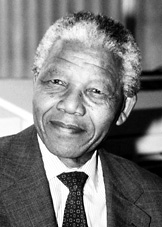
Nelson Mandela
Nelson Mandela was inaugurated as president of South Africa in 1994. The anti-apartheid icon served until 1999 and died in 2013. Children can learn more at: Nelson Mandela.
Nelson Mandela
Nelson Mandela was inaugurated as president of South Africa in 1994. The anti-apartheid icon served until 1999 and died in 2013. Children can learn more at: Nelson Mandela.
Caroline B. Cooney (born Geneva, Connecticut, 1943) has written at least 75 mystery, romance, and suspense novels for young adults. Her books include The Face on the Milk Carton and What Janie Found. Young adults can learn more at: Caroline B. Cooney.
Christopher Paul Curtis (born Flint, Michigan, 1953) is an author. His book The Watsons Go to Birmingham – 1963 was a 1996 Newbery Honor Book and a 1996 Coretta Scott King Honor Book. His Bud, Not Buddy was awarded the 2000 Newbery Award and the 2000 Coretta Scott King Medal. Also, Elijah of Buxton received a 2008 Newbery Honor Award, the 2008 Coretta Scott King Award, and the 2008 Scott O’Dell Award for Historical Fiction!
Robert Gray (born 1755; died at sea near Charleston, South Carolina, July 1806) was the first American to circumnavigate the world. He sailed from Boston on September 30, 1787 and traded with the Northwest Coast Indians. He traveled to China before returning to Boston on August 9, 1790.
Judith Jamison (born Philadelphia, Pennsylvania, 1944; died New York, New York, November 9, 2024) was a dancer and a choreographer.
Bruce McMillan (born Massachusetts, 1947) has written at least 45 books for children. His works include Nights of the Pufflings and The Problem with Chickens. Children can learn more at: Bruce McMillan.
Ellen Ochoa (born Los Angeles, California, 1958) Is the first Hispanic woman to go into space. An engineer, Dr. Ochoa has flown in four Space Shuttle missions: STS 56, STS 66, STS 96, and STS 110. She was Director of the Johnson Space Center from January 1, 2013 until May 2018. Children could learn more at: Ellen Ochoa
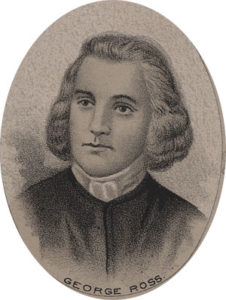
George Ross
George Ross (born New Castle, Delaware, 1730; died Philadelphia, Pennsylvania, July 14, 1779) signed the Declaration of Independence. He moved from Delaware to Pennsylvania and became a lawyer. Initially he was a prosecutor for the Crown, but he ultimately sided with the revolutionaries. He was a colonel during the Revolutionary War, and later he was a judge for the Admiralty Court of Pennsylvania. Children could learn more at: George Ross.

Minnesota State Flag
Minnesota became the thirty-second state of the United States in 1858. Its name is derived from the Sioux word minisota, meaning sky-tinted waters. It was settled by the French looking for furs. Its nicknames are the North Star State and the Gopher State. Minnesota is the twelfth largest state, and it ranks 21st in terms of population. Minnesota has over ten thousand lakes, and the Mesabi Range produces about 60 percent of the country’s iron ore. Children could learn more at: Minnesota.
Peter Stuyvesant became governor of New Amsterdam in 1647. A strongly opinionated individual, he served as governor until 1664 when England took over the colony and renamed it New York.
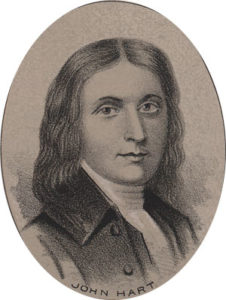
John Hart
John Hart, one of the signers of the Declaration of Independence, died in 1779 in Hopewell, New Jersey. He was born around 1711 in Stonington, Connecticut, but his exact date of birth is unknown. He represented New Jersey at the signing. When the British attacked New Jersey, they placed a bounty on Hart. He was forced to hide. When he was finally able to return to his farm, he found that his wife had died and that his children had moved. Children could learn more at: John Hart.
Merrimack was destroyed by the Confederate Navy in 1862. Southern military leaders thought advancing Union troops might capture the ironclad, so Confederate officials sank the ship.

MacDonald Lake in Glacier National Park
Glacier National Park was established in 1910. Located in northwest Montana on the United States-Canada border, the park encompasses a million acres. Children could visit an Internet site at: http://www.nps.gov/glac/index.htm. They could also find out how glaciers and icebergs are formed at: Glaciers.
Irving Berlin (born Israel Isidore Baline in Tyumen, Russia, 1888; died New York, New York, September 22, 1989) wrote approximately 1,250 songs. Two of his most famous works are God Bless America and White Christmas.
Sheila Burnford (born Scotland, 1918; died England, April 20, 1984) was an author. She is best remembered for her book The Incredible Journey.
Salvador Dali (born Figueras, Spain, 1904; died Figueras, Spain, January 23, 1989) was a surrealist painter.
Martha Graham (born Allegheny, Pennsylvania, 1894; died New York, New York, April 1, 1991) was a dancer and a choreographer.
Juanita Havill (born Evansville, Indiana, 1949) writes books for children. Her books include Jamaica’s Find and Eyes Like Willy’s.
Mike Lupica (born Oneida, New York, 1952) is a sports columnist and writer. His books for children include Heat and Travel Team. Young adults can learn more at: Mike Lupica.
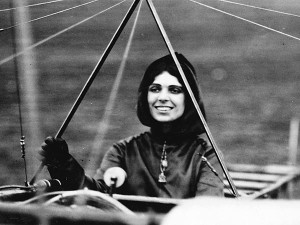
Harriet Quimby
Harriet Quimby (born Arcadia Michigan, 1875; died Quincy, Massachusetts, July 1, 1912) was an early female aviator. She was the first American woman to obtain a pilot’s license. In 1912 she was the first woman to fly across the English Channel. She died in an airplane-related accident later that year.
Peter Sis (born Brno, Moravia, Czechoslovakia, 1949) writes and illustrates books for children. He has received many awards for his books. He has received three Caldecott Honor Awards: Starry Messenger: Galileo Galilee in 1997, Tibet Through the Red Box in 1999, and The Wall: Growing Up behind the Iron Curtain in 2008. The last book also earned the Robert F. Sibert Medal for Informational Books. Sis has also earned the very prestigious Han Christian Andersen Award for Illustration in 2012.
Zilpha Keatley Snyder (born Lemoore, California, 1927; died San Francisco, California, October 8, 2014) wrote at least 46 books for children. She received three Newbery Honor  Awards: The Egypt Game in 1968, The Headless Cupid in 1972, and The Witches of Worm in 1973.
Limerick Day is today, honoring the birth of Edward Lear. Lear, an artist, musician, and writer, is particularly famous for his limericks. A limerick is a five-line poem. The first, second, and fifth lines rhyme and have three metrical feet. The third and fourth lines rhyme and each have two metrical feet. Limericks are often humorous and sometimes not child appropriate. Find more information about Lear in today’s Birthdays section.
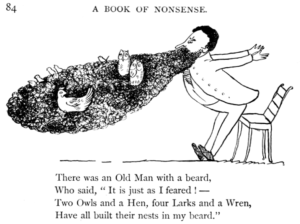
Lear’s Limerick (four lines)
 Washington Monument reopened in 2014. Repairs to the monument due to the 5.8 magnitude east coast earthquake of August 23, 2011, were completed. About 150 cracks had to be repaired. The scaffolding that was necessary to repair the monument has been removed. Children can learn more at: http://www.nps.gov/wamo/index.htm.