Tin-type camera was patented by Hamilton Smith of Gambier, Ohio, in 1856. Idea: Children could learn how the tin-type was different from other kinds of cameras.
Feb 192026
Tin-type camera was patented by Hamilton Smith of Gambier, Ohio, in 1856. Idea: Children could learn how the tin-type was different from other kinds of cameras.
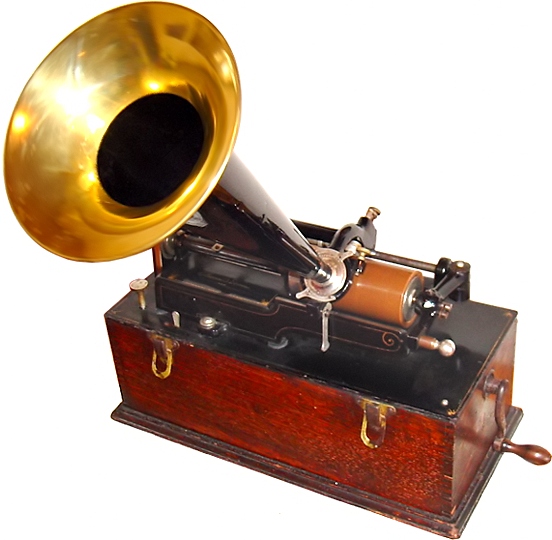
Gramophone
Gramophone, later called the phonograph, was patented by Thomas Edison in 1878. He received patent number 200,521. Older children could learn more about the history of sound recording at: Gramophone.
President Roosevelt ordered the internment of about 110,000 Japanese-Americans in 1942. They were sent to concentration camps in western states. They lost their property, valued at about four hundred million dollars. Children could find out more about the reasons behind Roosevelt’s decision. What was life like in the concentration camps? They could learn more at: Japanese Relocation. Students might also read Farewell to Manzanar by Jeane W. Houston and James D. Houston.
National Muffin Day is today! An English muffin is very different from an American muffin, but both are mighty tasty! Idea: Children could list all the types of muffins they can think of and then decide on their favorite.
Frederick Douglass died in Anacostia Heights, DC, in 1895. He was born in Tuckahoe, Maryland, probably in February 1818. He escaped from slavery and became a popular abolitionist and speaker. Children can learn more at Frederick Douglass. Children can also read some of his works at Project Gutenberg.

John Glenn
John Glenn in 1962 was the first American and the third person to orbit the earth. He circled the earth in Friendship 7 three times in almost five hours.
At the age of 77, he returned to space on the space shuttle Discovery, when he participated in scientific experiments from October 29 to November 7, 1998. He was at that time the oldest person to venture into space. Children could learn more at: John Glenn.

Mir Space Station
Mir space station was launched by the Soviet Union in 1986. It was home to both Soviet and American scientists until March, 2001.
The Cherokee Phoenix, published on a weekly basis in Georgia, became in 1828 the first Native American newspaper. It stopped publication in 1834, but today an electronic version is still being published.
Sarah G. Bagley became the first female telegraph operator in 1846. A women’s rights advocate, she also worked to make millwork safer for women. Children could read an excellent biography of her at: Sarah G. Bagley.

Lucy B. Hobbs
Lucy B. Hobbs became the first woman dentist when she graduated from the Ohio College of Dental Surgery in Cincinnati, Ohio, in 1866. She practiced dentistry for over 20 years. She then turned her attention to politics and women’s rights.
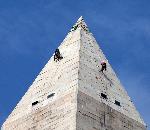
Rappelling on Washington Monument to Assess Earthquake Damage
Washington Monument was dedicated in 1885. The first plans for the Washington Monument were quite elaborate, including a likeness of Washington in a chariot. Ultimately the plans were simplified to a plain obelisk. Construction began in 1848, but the Civil War and lack of funds stopped work. After the War, construction began again. Children can learn more at: http://www.nps.gov/wamo/index.htm.