Ford Motor Company, in 1958, produced its 50 millionth car, the Thunderbird.
General Motors, in 1968, produced its 100 millionth car, the Oldsmobile Toronado.

Ford Motor Company, in 1958, produced its 50 millionth car, the Thunderbird.
General Motors, in 1968, produced its 100 millionth car, the Oldsmobile Toronado.
William Blount (Born Bertie, County, North Carolina, 1749; died Knoxville, Tennessee, March 21, 1800) represented North Carolina at the Constitutional Convention. Children can learn more at: William Blount.
George Clymer (born Philadelphia, Pennsylvania, 1739; died Philadelphia, Pennsylvania, January 24, 1813) was an American patriot. He was one of six men to sign both the Declaration of Independence and the Constitution. Later he served as a representative from Pennsylvania during the first term of the House of Representatives. Children can learn more at: George Clymer.
Sid Fleischman (born Brooklyn, New York, 1920; died Santa Monica, California, March 17, 2010) wrote at least 35 books for children. He received the 1987 Newbery Medal for The Whipping Boy. Another one of his excellent books is By the Great Horn Spoon! His son is writer Paul Fleischman. Children can visit a website devoted to him at: Sid Fleischman. In 2003 the Society of Children’s Book Writers and Illustrators honored Fleischman by creating the Sid Fleischman Humor Award, rewarding authors who incorporate laughter into their books. Fleischman received the first award in 2003. Children can learn more about the award and the recipients at: Sid Fleischman Award. Children could read a biography of Fleischman and learn more about the Sid Fleischman Award by reading Children’s Book Award Handbook, by Diana F. Marks.
Caroline Lucretia Herschel (born Hanover, Germany, 1750; died Hanover, Germany, January 9. 1848) was an astronomer. Sister of famous astronomer William Herschel, she became a well-regarded astronomer in her own right. She was the first woman to discover a comet (comet 35-P/Herschel-Rigollet). She also produced Catalogue of Stars, an index of all stars that had been observed and cataloged. Children could learn more at: Caroline Lucretia Herschel. They could also read Caroline’s Comets by Emily Arnold McCully.
Eric P. Kelly (born Amesbury, Massachusetts, 1884; died January 3, 1960) was a journalist and writer of children’s books. He wrote at least fifteen books, and his book The Trumpeter of Krakow received the 1929 Newbery Medal.
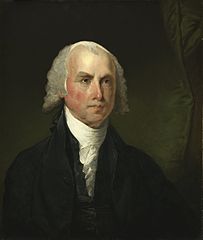
James Madison
James Madison (born Port Conway, Virginia, 1751; died Montpelier, Virginia, June 28, 1836) was the fourth president (1809-1817) of the United States. He is known as the “Father of the Constitution” because he continually pushed and pulled the delegates into meeting and resolving differences. He also wrote the first draft of the Bill of Rights. He was a Congressperson for four terms. While he was president, he had to contend with the War of 1812. Children could visit a website at: James Madison. They could read Jean Fritz’s The Great Little Madison.

Patricia Nixon
Thelma Catherine Patricia Ryan Nixon (born Ely, Nevada, 1912; died Park Ridge, New Jersey, June 22, 1993) was America’s First Lady from January 20, 1969 to August 9, 1974. She was the wife of Richard M. Nixon, thirty-seventh president of the United States. She met Nixon when she was teaching in Whittier, California. During World War II, she worked as a government economist. Children could visit a website at: Pat Nixon.
Georg Simon Ohm (born Erlangen, Germany, 1787; died Munich, Germany, July 6, 1854) was a physicist. He originated Ohm’s Law. The ohm, a measure of electrical resistance, honors him. Children could find out more about Ohm’s Law and electrical resistance. They could learn more at: Georg Simon Ohm.
 Saint Patrick’s Day remembers the death of Bishop Patrick, patron saint of Ireland. Bishop Patrick was born circa AD 389 and died circa AD 461. Born in England, he brought Christianity to Ireland. Little is really known about his life. Children could read St. Patrick’s Day by Gail Gibbons. They could also write stories that include leprechauns, rainbows, and pots of gold. They could also wear green and eat green fruits and vegetables.

Flag of Ireland
Ireland celebrates its national holiday, Saint Patrick’s Day. Slightly smaller than the state of West Virginia, Ireland has 4.6 million people. Dublin is the capital. Children could learn more at: Ireland.
Rubber band was patented by Stephen Perry, a British citizen, in 1845. He developed the rubber band, made from natural rubber, to keep papers and envelopes together. Children could list the ways we use rubber bands today.
First glider flight in the United States occurred in 1893. John Joseph Montgomery flew his glider near Otay, California.
First submarine was launched in 1898. John Phillip Holland, owner of the John P. Holland Torpedo Boat Company, created the Holland Submarine. It submerged for about 100 minutes in a shipyard in Elizabethtown, New Jersey.
Campfire Girls of America was created in 1910. In 1975 the group decided to admit boys and changed the name to Campfire Girls and Boys of America. In 2001 the group changed its name to Camp Fire USA, and in 2012 another name change produced Camp Fire. Children could learn more at: Camp Fire.
National Gallery of Art opened in 1941 in Washington, DC. President Franklin Roosevelt officiated at the opening. The museum was created in 1937 when a number of wealthy art collectors donated many of their acquisitions to become the core of the exhibits. It has a fine collection of artwork, ranging from the medieval period to the present. Children could visit the Internet site, especially the online tours, at: http://www.nga.gov. They could also pretend to be curators for the National Gallery of Art and decide which works of art to add to the collection. They could also view the amazing children’s portion of the website at: NGA Kids.
Jim Bridger (born Richmond, Virginia, 1804; died near Kansas City, Missouri, July 17, 1881) was a scout and pioneer. He built Fort Bridger in Wyoming as a fur trading post and rest station for settlers traveling on the Oregon Trail.
Gottlieb Wilhelm Daimler (born Schorndorf, Kingdom of Wurttenberg, Germany, 1834; died Bad Cannstatt, Kingdom of Wurttenberg, German Empire, March 6, 1900) is known as the “Father of the Automobile.” He invented the internal combustion engine. Idea: Help students discover how a car engine actually works.
Ralph Fletcher (born Marshfield, Massachusetts, 1953) writes novels, picture books, and poetry books for children and young adults. His books include Fig Pudding and Moving Day.
Kate Greenaway (born London, England, 1846; died London, England, November 6, 1901) wrote and illustrated children’s books. Children can read many of her works at: Project Gutenberg. The highly respected Kate Greenaway Medal is given each year to the best-illustrated book published in the United Kingdom. Children could learn more about Kate Greenaway and the Kate Greenaway Medal by consulting the Children’s Book Award Handbook, by Diana F. Marks.
Lilian Moore (born New York, New York, 1909; died Seattle, Washington, July 20, 2004) wrote about 50 poetry books and easy-to-read books for children. Her works included While You Were Chasing a Hat and I’ll Meet You at the Cucumbers. Children can learn more at: Lilian Moore.