Constitutional Convention met from August 6 to September 10, 1787. This Philadelphia meeting was called the “Great Debate,” and the purpose was to draft a constitution. Idea: Children could read Shh! We’re Writing the Constitution, written by Jean Fritz. Older children could learn about the members at an EXCELLENT site: Framers.

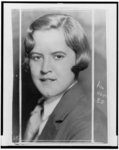
Gertrude Ederle
Gertrude Ederle in 1926 became the first woman to swim the English Channel. She swam for 14 hours 31 minutes from England to France. She returned to a ticker tape parade in New York City. Younger children could read America’s Champion Swimmer: Gertrude Ederle, by David A. Adler. At least 45 other people have successfully swum the English Channel.
Atomic bomb was dropped on Hiroshima in 1945. The Enola Gay, a B-29 bomber, dropped the bomb that immediately killed 70,000 to 80,000 people. Within four months another 90,000 to 140,000 people died from radiation sickness and other complications of the atomic bomb. The United States dropped an atomic bomb on Nagasaki on August 15, 1945. The Japanese informally surrendered on August 15, 1945 and formally surrendered on September 2, 1945. Older students could read Hiroshima by John Hersey. The book follows several Japanese citizens after the bomb drop and then about 40 years later.
World Wide Web became available to the public in 1991. Sir Tim Berners-Lee developed a system of sharing files between computers. Within five years 40 million people were using the Web. Today almost 2.5 billion people use the Web. Berners-Lee could have become wealthy from his invention, but he wanted the Web to remain free and open. Children would find the following timeline interesting: Timeline.
Frank Asch (born Somerville, New Jersey, 1946) is a children’s author and illustrator. He has published over 60 books; he is known for his Moonbear series.
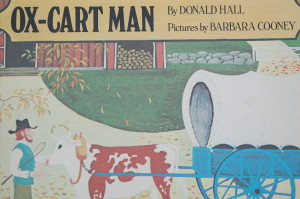
Ox-Cart Man
Barbara Cooney (born Brooklyn, New York, 1917; died Portland, Maine, March 10, 2000) was a children’s author and illustrator. She illustrated at least 70 books. Her illustrations in Chanticleer and the Fox won the 1959 Caldecott Medal, and her illustrations in Ox-cart Man won the 1980 Caldecott Medal. Children can visit a website at: Barbara Cooney.
Sir Alexander Fleming (born Lochfield, Scotland, 1881; died London, England, March 11, 1955) was a bacteriologist. He discovered penicillin and received the 1945 Nobel Prize in Physiology or Medicine.
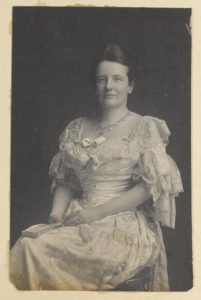
Edith Kermit Carow Roosevelt
Edith Kermit Carow Roosevelt (born Norwich, Connecticut, 1861; died Sagamore Hill, New York, September 30, 1948) was America’s First Lady from September 14, 1901 to March 4, 1909. She was the second wife of Theodore Roosevelt, twenty-sixth president of the United States. They had five children, and he also had a daughter, Alice, by his first marriage. Children could visit a website at: Edith Roosevelt. Idea: Children could investigate what the Roosevelt children did while they were living in the White House. Did they really take a pony upstairs?
Alfred, Lord Tennyson (born Somersby, Lincolnshire, England, 1809; died Aldworth, England, October 6, 1892) was a poet. Children could read many of his works at: Project Gutenberg.
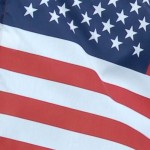
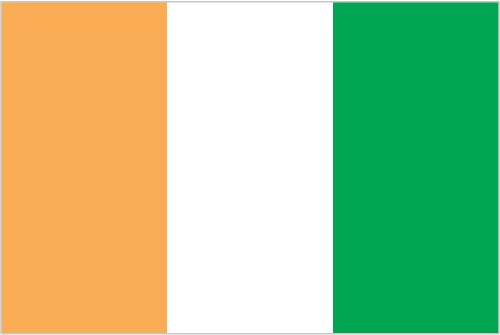
Flag of Cote D’Ivoire
Cote D’Ivoire celebrates Independence Day. The west African country gained its independence in 1960 from France. Bordering the Atlantic Ocean, Cote D’Ivoire has an area about the same as the area of New Mexico. The mostly flat country has a tropical climate along the coast. The country exports cocoa beans and coffee beans. Over 22 million people live there, and Yamoussoukro is the capital.
Purple Heart was created by General George Washington in 1782 to be the Badge of Military Merit. Experts believe only three medals were awarded by Washington during the Revolutionary War. The medal was not given again after Word War I. Approximately two million Purple Heart Medals have been awarded to those wounded or killed during military action. The badge was made of purple cloth with silver braided trim.
United States War Department was created in 1789 by Congress. In 1949 it was renamed the Department of Defense. Retired General Henry Knox was the first Secretary of War and a member of President George Washington’s five-person cabinet.

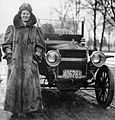
Alice Huyler Ramsey
Alice Huyler Ramsey and three fellow female travelers in 1909 became the first women to drive across the country by automobile. They had left Manhattan on June 9, 1909, and finished in San Francisco, California. Only Ramsey could drive! She had to replace flat tires, fix brake pedals, and make other repairs. Only 152 miles of the 3,600 mile trip were paved. Ramsey wrote Veil, Duster, and Tire Iron to commemorate her trip. Older children could learn more at: Alice Huyler Ramsey.

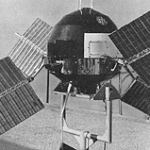
Explorer VI
Explorer VI was launched in 1959 and transmitted the first photographs of earth taken from space. The satellite also transmitted data about different types of energy. The satellite went into decay on July 1, 1961. Older children could learn more at: Explorer VI.