America Recycles Day is today! Also called National Recycling Day, the day was created in 1994 when President Bill Clinton issued a proclamation recognizing the day. Today Keep America Beautiful sponsors the day. Idea: Children could carry out a local recycling project. They could learn some great recycling facts at: Recycling Facts.
Japan celebrates Shichi-Go-San. The day translates as “Seven-Five-Three.” Parents take their seven-year-old girls, five-year-old boys, and three-year-olds of either sex to the temples. They thank the guardian spirits for protecting the children and keeping them healthy.
Jeremiah Dixon and Charles Mason started to survey the Mason-Dixon Line in 1763. This line marked the border between Pennsylvania and Maryland. They finished their work on December 26, 1767. Originally their work was to settle a very contentious land dispute between the Penn family (Pennsylvania) and the Calvert family (Maryland). Later, as the Civil War approached, the line somewhat divided the country into the north and the south. Older children could read about the history of the Mason-Dixon Line at: Mason-Dixon Line.

Pikes Peak – 1899 print
Zebulon Pike recorded seeing Pikes Peak in Colorado in 1806. The mountain, with an elevation of 14,115 feet, is a National Historic Landmark. Katharine Lee Bates wrote “America the Beautiful” after visiting the peak.

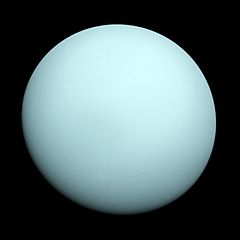
Uranus
William Herschel (born Hanover, Germany, 1738; died Slough, England, August 25, 1822) was an astronomer. He discovered Uranus in 1781 and found that it rotated in a direction different from the directions of other planets. He was also active in star astronomy, and he discovered infrared radiation. Older children could learn more at: William Herschel.
Georgia O’Keefe (born Sun Prairie, Wisconsin, 1887; died Santa Fe, New Mexico, March 6, 1986) was an artist. Her works featured nature, and she often painted objects as if she was looking at something under a magnifying glass. She was married to the photographer Alfred Stieglitz. You can see her home, examine her art materials, and view great online exhibits at: Georgia O’Keefe.
Daniel Pinkwater (born Memphis, Tennessee, 1941) is a children’s author and illustrator. He has published at least 100 books, including Mrs. Noodlekugel. One of his latest books is Crazy in Poughkeepsie. Children can visit his website where you can hear him read several of his books: Daniel Pinkwater.

Oklahoma Flag
Oklahoma became the forty-sixth state of the United States in 1907. French trappers visited the area around 1700. Several Native American groups were relocated to Oklahoma, only to be forced out later. Oil and gas were and still are important sources of income. Oklahoma’s name can be traced to a Choctaw word okla humma, meaning land of the red people. Its nickname is the Sooner State. Oklahoma ranks 20th in size and 35th in population. Oklahoma City is the capital. Idea: Oklahoma has a panhandle. Children could look at a United States map and find out which other states also have panhandles.
Daniel of St. Thomas Jenifer died on November 16, 1790. His exact date of birth is unknown. He represented Maryland at the Constitutional Convention. Before the Revolutionary War, he was active in settling border disputes between Maryland and Pennsylvania. Older children could learn more at: Daniel of St. Thomas Jenifer.
Venera 3, a Soviet unmanned space probe, was launched in 1965. It crash landed on the surface of Venus on March 1, 1966. It was the first man-made object to travel to another planet. Children could figure out how many days it took to get to Venus and the distance it traveled. They could make various math problems from those statistics.

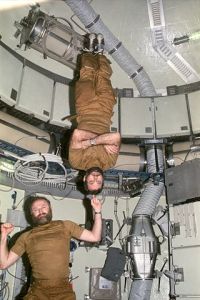
Carr “balances” Pogue in weightless conditions
Skylab 4, with three astronauts, was launched in 1973. The crew (Commander Gerald P. Carr, Pilot William R. Pogue, and Scientist Edward G. Gibson) spent over 84 days in space, returning to earth on February 8, 1974. Daily life in space is much different from daily life on earth. Marianne J. Dyson wrote a very interesting book, Space Station Science: Life in Free Fall. She provides some easy and fascinating experiments. I like her chapter on space bathrooms. Children could also learn more at: Skylab 4.
Artemis I lifted off in 2022. The rocket sent Orion, the upper stage without humans aboard, toward the moon. Orion circled the moon for several days and then splashed down in the Pacific on December 11. Data regarding the project indicated how to improve future Artemis missions that will send astronauts back to the moon. The rocket launched from Cape Kennedy Space Center. Older children can learn more at: Artemis.