Early Bird satellite (Intelsat I) in 1965 made telephone calls from the United States to Europe more practical. It also helped television transmissions. Expected to last about eighteen months, it was active for four years four months. It was reactivated briefly in 1990 to celebrate its 25th anniversary, and it remains in orbit. Idea: Children could find out how calls were made before the satellite and how the satellite worked. They could also learn more at: Early Bird.

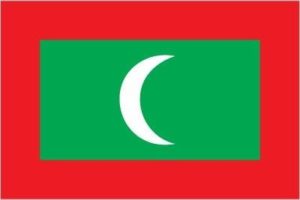
Flag of Maldives
Maldives celebrate Independence Day. Great Britain gave up control of the coral islands in 1965. About 1,200 islands make up this country located in the Indian Ocean. In total the area of the islands is about 1.7 times the area of the Washington, DC. Almost 400,000 people live there, and many derive their income from the tourist industry. Male is the capital.

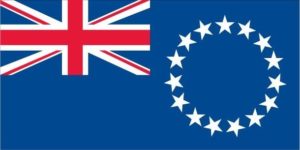
Flag of Cook Islands
Cook Islands celebrate Constitution Day. In 1965 the populace approved a constitution that gives them autonomy in free association with New Zealand. The area of the fifteen islands is about 1.3 times the size of Washington, DC. The northern islands are coral atolls, and the southern islands are vestiges of volcanic activity. About 10,500 people live there, mostly on the southern islands. The capital is Avarua. The islands are named after Captain James Cook, who saw one of the islands in 1793.

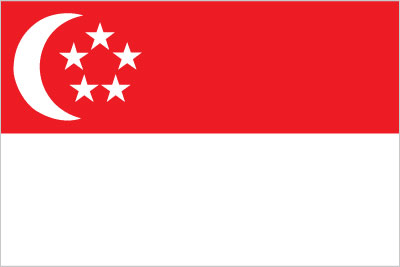
Flag of Singapore
Singapore celebrates National Day. In 1965 Singapore gained its freedom from the Malaysian Federation. According to the CIA World Factbook, Singapore is about 3.5 times the size of Washington, DC. It has a tropical climate, and over five million people live there. Children can learn more at: Singapore.

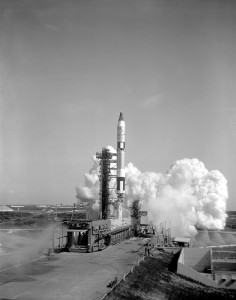
Gemini 5 Liftoff
Gemini 5 was launched into space in 1965. For eight days astronauts L. Gordon Cooper and Pete Conrad orbited the earth. While orbiting the earth 128 times, they launched the first satellite from a manned craft. They returned to earth on August 29, 1965. Older children can learn more at: Gemini 5.
Venera 3, a Soviet unmanned space probe, was launched in 1965. It crash landed on the surface of Venus on March 1, 1966. It was the first man-made object to travel to another planet. Children could figure out how many days it took to get to Venus and the distance it traveled. They could make various math problems from those statistics.
Dale Cummings, a high school senior, did 14,118 sit-ups in 1965.

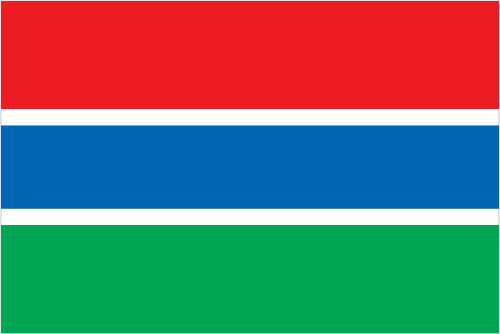
Flag of The Gambia
The Gambia celebrates Independence Day. It gained its independence from Great Britain in 1965. Banjul is the capital of this small country, located on the northwestern coast of Africa. According to the CIA World Factbook, The Gambia is about twice the size of Delaware. Almost two million people live in The Gambia, and about 75 percent of its inhabitants are farmers.
Venera 3, a Soviet unmanned space probe, crash landed on the surface of Venus in 1966. It was launched on November 16, 1965. It was the first man-made object to travel to another planet.
Aleksei Leonov, a Soviet cosmonaut, became the first person to walk in space in 1965. His space walk lasted a bit over twelve minutes, and he was connected to his spacecraft by a tether.