Feb 232025
 
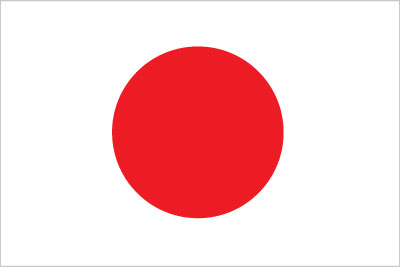
Japan

Flag of Japan

Japan celebrates a national holiday, the birthday of Emperor Naruhito. The country is composed of a series of mountainous islands. The total area is about the area of California. About 127 million people live in Japan, and Tokyo is the capital. Emperor Naruhito was born in 1960. Children can learn more at: Japan.

Feb 232025
 
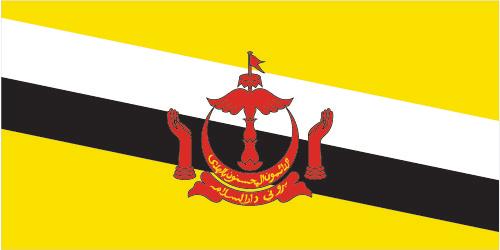
Brunei

Flag of Brunei

Brunei celebrates a national holiday. Located on the island of Borneo, it became free of British rule in 1984. This small country (according to the CIA World Factbook, slightly smaller than Delaware) is governed by a sultan, Hassanal Bolkiah. Extremely rich deposits of oil have made Brunei a wealthy country. Around 400,000 people live in the country, and the capital is Bandar Seri Begawan.

Feb 232025
 
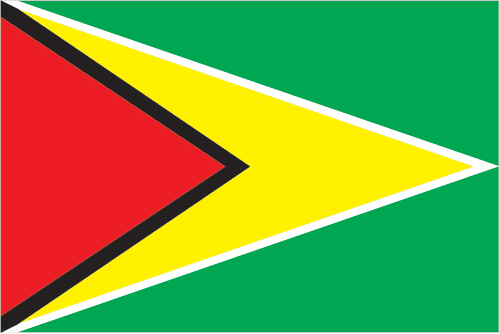
Guyana

Flag of Guyana

Guyana celebrates Republic Day. Guyana is the only English-speaking country in South America. Various European countries laid claim to the country, located on the northeastern coast of South America. According to the CIA World Factbook, Guyana is about the size of Idaho. Because the country has a tropical climate, inhabitants grow sugar, rice, and timber. It also exports gold and bauxite. Over 700,000 people live in Guyana. Georgetown is the capital.

Feb 232025
 

George Taylor, signer of the Declaration of Independence, died in Easton, Pennsylvania, in 1781. He was born in Ireland, probably during 1716. He also helped the cause of the Revolutionary War because his forge produced grapeshot, cannonballs, and cannons. Idea: Children could find out how grapeshot and cannonballs were made. Children could learn more at: George Taylor.

Feb 232025
 
Children Waiting for Polio Vaccine

Children Waiting for Polio Vaccine

First mass inoculations of Salk polio vaccine took place in 1954. Polio was a terrifying disease affecting thousands of children. Jonas Salk’s vaccine brought relief for families around the world. To understand more about polio’s devastation, children can read Peg Kehret’s excellent autobiography, Small Steps: The Year I Got Polio.

Feb 232025
 

C. S. Adler (born Long Island, New York, 1932) has written 44 books for children. Her books include The Magic of the Glits and No Place Cat. Children can visit her website at: C. S. Adler.

W. E. B. Du Bois (born Great Barrington, Massachusetts, 1868; died Accra, Ghana, August 27, 1963) was a famous African American leader striving for equality. A professor, activist, and author, he was one of the co-founders of the NAACP. Children can read many of his works at: Project Gutenberg. Also, children can learn more at: W. E. B. Du Bois.

George Frederick Handel (born Halle, Saxony, Germany, 1685; died London, England, April 14, 1759) was a composer of Baroque music. One of his best known works is Messiah, first performed in 1742.

Walter Wick (born Hartford, Connecticut, 1953) is a photographer and author of children’s books. He is most known for his I Spy series and his Can You See What I See? series. Children can visit his fascinating website at: Walter Wick.
Feb 242025
 
Estonia

Flag of Estonia

Estonia celebrates Independence Day. Located along the Gulf of Finland, Estonia has had a complicated history. In 1918 it became free of Soviet rule, but then it was conquered again. It became free of Soviet rule for the second time in 1991. According to the CIA World Factbook, Estonia is about the size of Vermont and New Hampshire combined. Bordering the Baltic Sea and the Gulf of Finland, Estonia is home to 1.2 million people. Tallinn is the capital.

Feb 242025
 

Pope Gregory XIII in 1582 issued a ruling stating the Julian calendar would be corrected in October 4 of the same year. The Julian calendar, the then-existing calendar, was erring by ten days. The new calendar, called the Gregorian calendar, did the following:
• Ten days were not included in October
• New standards were set to determine Easter
• New rules were established regarding Leap Day
Not everyone adopted the Gregorian calendar right away. Even those who adopted the calendar were not happy because they thought they had lost ten days of pay. Great Britain and colonial America did not change until September 1752. We still use the Gregorian calendar today.