 Amendment Twenty-Four to the Constitution was adopted in 1964. It eliminated poll taxes and other taxes designed to prevent people from voting.
Jan 232025
Amendment Twenty-Four to the Constitution was adopted in 1964. It eliminated poll taxes and other taxes designed to prevent people from voting.
John Hancock (born Braintree, Massachusetts, 1737; died Quincy, Massachusetts, October 8, 1793) was an American patriot. He deliberately made his signature on the Declaration of Independence very prominent. His political activities irritated the British, and they started the famous march to Concord. After the war, he served as governor of Massachusetts for a number of years. Idea: Show the children a copy of the Declaration of Independence and his famous signature. Have a signature writing event where they try to copy his style. Jean Fritz wrote Will You Sign Here, John Hancock? Children might enjoy reading the book. Children could also learn more at: John Hancock.
Gertrude Belle Elion (born New York, New York, 1918; died Chapel Hill, North Carolina, February 21, 1999) was a scientist and inventor. In 1988 she was one of two people to earn the Nobel Prize in medicine for her work finding anti-leukemia drugs. In 1991 she became the first woman to be inducted into the National Inventors Hall of Fame. She received 45 patents before she died in 1999. Children can learn more at: Gertrude Belle Elion.
Joseph Hewes (born Kingston, New Jersey, 1730; died Philadelphia, Pennsylvania, November 10, 1779) signed the Declaration of Independence. He represented North Carolina. The son of Quakers, he started his career as an apprentice to a merchant. Soon he moved to North Carolina and became a very successful merchant using many ships. At first he opposed a break with England, but he changed his mind. He worked tirelessly to establish a navy for the colonies. However, he died before the Revolutionary War ended. Children could learn more at: Joseph Hewes.
Edouard Manet (born Paris, France, 1832; died Paris, France, April 30, 1883) was an impressionist painter. Born into a wealthy family, he counted Monet, Renoir, Degas, and Pissarro as friends. His brother married the painter Berthe Morisot. His paintings shocked the art community at the time. Children could visit a website at: Manet.
peanut butter sandwich
National Peanut Butter Day is today! Children can make their own peanut butter. They can pour into a blender about three cups shelled and roasted peanuts. They should also add a pinch of salt. They can add the cover and blend until smooth. They can add a bit of vegetable oil if necessary to increase smoothness.
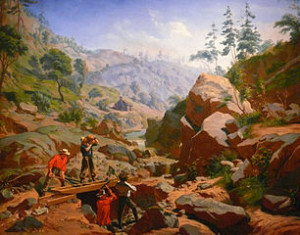
California Miners
Photograph Ad Meskens
Gold was discovered in California in 1848 by John Sutter and John Marshall. They were building a sawmill when they noticed flakes of gold in the water. Most of the forty-niners rushed to the Mother Lode country, part of the western foothills of the Sierra Nevadas. Over 90,000 people had reached California by 1849, and the population topped 220,000 by 1852. The rush had declined by 1854, and most prospectors turned to other jobs. Idea: Children could find out how mine claims are made legal and how assays prove metal content of ore. Children could learn more at: California Gold. Children would really enjoy reading Sid Fleischman’s excellent historical fiction book By the Great Horn Spoon!
Voyager 2 sailed past Uranus in 1986. It discovered eleven new moons and two new rings. Voyager 2 collected data on one of the moons, Miranda. Miranda, named after a character in William Shakespeare’s The Tempest, is gouged by deep craters and sharp cliffs. Voyager 2 was launched on August 20, 1977, and it still sends back data about deep space! Idea: Children could find out how newly discovered objects in space are named. Children can learn more, including a great mission time elapsed clock, at: Voyager 2.

The Great Quest
Charles Boardman Hawes (born Clifton Springs, New York, 1889; died Springfield, Massachusetts, July 16, 1923) wrote children’s books. His book The Great Quest received a 1922 Newbery Honor Award. The 1924 Newbery Medal was awarded posthumously to him for The Dark Frigate. Children can read The Great Quest at: http://www.gutenberg.org/.
Mary Lou Retton (born Fairmont, West Virginia, 1968) is an Olympic gold medal winner in gymnastics.
Maria Tallchief (born Elizabeth Marie Tall Chief in Fairfax, Oklahoma, 1925; died Chicago, Illinois, April 11, 2013) was America’s first prima ballerina. A member of the Osage tribe, she originally studied to be a pianist. She established the Chicago City Ballet in 1979. Children could learn more at: Maria Tallchief.
Largest diamond, the Cullinan, ever found was discovered in the Premier Diamond Mining Company in Cullinan, South Africa in 1905. The stone, named after Sir Thomas Cullinan (owner of the mine), was 3,106 carats. The rough diamond was cut into seven very large gems and 96 smaller gems. Many of the larger gems are in the crown jewels of the United Kingdom. Idea: Have children illustrate how diamonds are made and how they are cut by visiting: Diamonds.
First transcontinental telephone call by Bell and Watson occurred in 1915. The famous duo of Alexander Graham Bell and Thomas A. Watson made history again. Watson was in San Francisco, California, when Bell called him from New York, New York. President Woodrow Wilson and the mayors of both cities were also part of the call. Bell’s first call to Watson (who was in another room in the same building) was on March 10, 1876.

Figure Skating at First Winter Olympics
Winter Olympics were held for the first time in 1924 in Chamonix, France. Approximately 258 athletes from sixteen nations competed in nine events. The United States sent 24 athletes and came home with four medals. Norway and Finland by far brought home the most medals. The events concluded on February 4, 1924. Children could hold their own winter events – sledding, snowball throwing at targets, biggest snowman competition.
Fluoridation process was added to drinking water in 1945 in Grand Rapids, Michigan. Idea: Children could find out how fluoride makes their teeth stronger. Children can learn more at: http://ilikemyteeth.org/fluoridation/.