National Anthem Day is today! “The Star-Spangled Banner” became the national anthem in 1931. Prior to 1931, the country had a number of patriotic songs but no national anthem. Little by little, various groups, including the navy, adopted the song. President Herbert Hoover signed the bill.
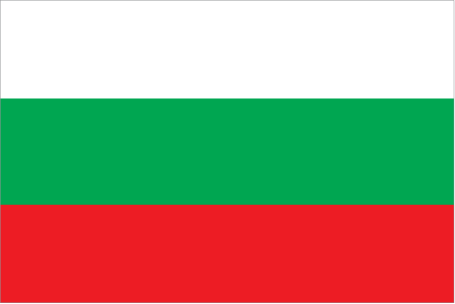

Flag of Bulgaria

Rila Monastery
Bulgaria celebrates Liberation Day. The country became an autonomous body under the Ottoman Empire in 1878. About the size of the state of Tennessee, Bulgaria borders the Black Sea, Romania, Serbia, Macedonia, Greece, and Turkey. The country exports textiles and footwear. Almost seven million people live in Bulgaria, and Sofia is the capital.
Hinamatsuri is celebrated in Japan. During this festival, girls cover a stairstep arrangement with red cloth and display their dolls. These dolls have been passed down from mother to daughter for generations. Blessings are placed on girls, and special foods are served. This website provides a great photo of a display and gives other good facts: Hinamatsuri.
Thomas L. Jennings patented “dry scouring clothes” in 1821. He became the first African American to receive a patent. He received Patent Number 3306X. Unfortunately his patent was lost in a fire, but experts believe the dry scouring was a form of dry cleaning. His process made him a successful businessman, and he spent much of his profits on the abolition movement.
Flag of Florida
Florida became the twenty-seventh state of the United States in 1845. Juan Ponce de Leon named the state Pasqua Florida, Easter festival of the flowers. The state capital is Tallahassee, and the state’s nickname is the Sunshine State. It ranks twenty-second in area and third in population. Most of the state is just above sea level. It is home to the Kennedy Space Center and Lake Okeechobee. Children could visit an Internet site at: Florida. They could also design a brochure regarding tourism in the state.
Alexander Graham Bell
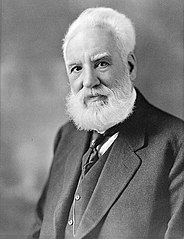
Alexander Graham Bell (born Edinburgh, Scotland, 1847; died Baddeck, Nova Scotia, Scotland, August 2, 1922) invented the telephone. Bell’s first call to Thomas Watson (who was in another room in the same building) was on March 10, 1876. The famous duo of Alexander Graham Bell and Thomas A. Watson made history again when the first transcontinental telephone call occurred on January 25, 1915. Watson was in San Francisco, California, when Bell called him from New York, New York. President Woodrow Wilson and the mayors of both cities were also part of the call. Bell also investigated causes of deafness. Children can learn more at: Alexander Graham Bell.
Jacqueline Joyner-Kersee (born East St. Louis, 1962) is an Olympic gold medalist in the heptathlon. She received the gold medal in the 1988 and 1992 Olympics. Sports Illustrated named her female athlete of the century.
Suse MacDonald (born Evanston, Illinois, 1940) writes and illustrates books for children. Her wonderful book Alphabatics received a 1987 Caldecott Honor Award. Other books include Dino Shapes and Circus Opposites.
Patricia MacLachlan (born Cheyenne, Wyoming, 1938; died Williamsburg, Massachusetts, March 31, 2022) wrote at least 60 children’s books. She wrote among other works Sarah, Plain and Tall, which received the 1986 Newbery Medal, the 1986 Scott O’Dell Award for Historical Fiction, and the 1986 Golden Kite Award. Other works include Before You Came and All the Places to Love.
George Pullman (born Brocton, New York, 1831; died Chicago, Illinois, October 19, 1897) invented the Pullman sleeping car for the railroad. Children could learn more at: George Pullman.

Mardi Gras
Mardi Gras is today! Mardi Gras (Fat Tuesday in French) is the last day before the start of Lent, the forty days before Easter. Today is a day of feasting and partying because Lent is not a time of feasting and partying. Special foods include doughnuts and a King Cake (complete with a small, plastic baby). Mardi Gras colors are purple, green, and gold. Many cities, including New Orleans, host Mardi Gras parades and other activities. Children can find Mardi Gras activities at: Mardi Gras.
William Penn received the deed to Pennsylvania from King Charles II in 1681. The deed was in lieu of paying a debt of sixteen thousand pounds. Children can learn more about Wiliam Penn at: William Penn.

Vermont State Flag
Vermont became the fourteenth state of the United States in 1791. A translation of the state’s name leads to its nickname, the Green Mountain State. The state is the sixth smallest in area, and only Wyoming has less population. Montpelier is the state capital. Two of its products are maple syrup and maple candy. Idea: Children could enjoy pancakes and real maple syrup.
Frances Perkins became the first female member of a Presidential cabinet in 1933. President Franklin D. Roosevelt appointed her to be Secretary of Labor. She carried out many aspects of the New Deal, including the Civilian Conservation Corps, major improvements to social security, and laws regarding child labor. She served until June 30, 1945. Children could learn more at: Frances Perkins.