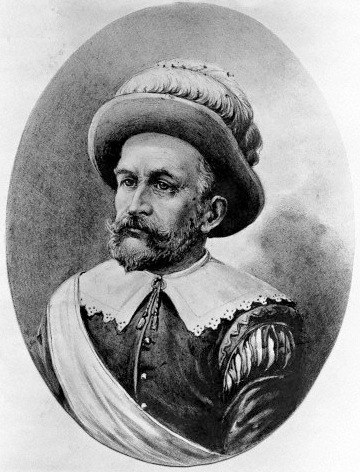
Peter Minuit
Peter Minuit arrived in what is now Manhattan in 1626. Representing the Dutch government, he purchased Manhattan for goods worth 60 guilders (24 dollars). Children could learn more at: Manhattan.
Peter Minuit
Peter Minuit arrived in what is now Manhattan in 1626. Representing the Dutch government, he purchased Manhattan for goods worth 60 guilders (24 dollars). Children could learn more at: Manhattan.
 Atlantis, an American shuttle spacecraft, was launched in 1989. It successfully deployed Magellan, which traveled to Venus to map the planet’s surface. Magellan encountered Venus on August 10, 1990 and began taking high-quality radar images on September 15, 1990. It continued to photograph the planet’s surface, making six complete mapping cycles. Magellan mapped about 98 percent of Venus’s surface. It was commanded to plunge into Venus’s surface, still sending data, on October 13, 1994. Children could learn more at: Magellan.
Doug Cushman (born Springfield, Ohio, 1953) has written and/or illustrated at least 125 books for children. His books include the Aunt Eater series and the Dirk Bones series. Children can learn more at: Doug Cushman.
Horace Mann (born Franklin, Massachusetts, 1796; died Yellow Springs, Ohio, August 2, 1859) is known as “the father of public education in the United States.” He was the editor of the Common School Journal. Idea: Children could find out more about Mann and his ideas about education.
Julia Gardiner Tyler (born Gardiner’s Island, New York, 1820; died Richmond, Virginia, July 10, 1889) was America’s First Lady from June 26, 1844 to March 4, 1845. She was the second wife of John Tyler, tenth president of the United States. They were married while he was president. Siding toward the Confederacy, John Tyler died before the beginning of the Civil War. Later, Congress voted to give her a pension. Children could visit a website at: Julia Gardiner Tyler.
Cinco de Mayo is celebrated in Mexico and the United States. The Battle of Puebla took place in 1862. General Ignacio Zaragoza led his Mexican army, outnumbered three to one, against Napoleon III’s French forces. Zaragoza won. Speeches, festivals, and parades are held nationwide. Young children could read Cinco de Mayo by Mary Dodson Wade. Idea: Children could have a Cinco de Mayo celebration. A piñata should be included.

Flag of Ethiopia
Ethiopia celebrates Freedom Day. Also known as Patriots’ Day, the day marks the 1941 end of Italy’s occupation of Ethiopia. Located in eastern Africa, it is the largest land-locked country in the world. The country’s area is a bit less than twice the area of Texas. It has small reserves of gold, copper, potash, and natural gas. Crops include maize, wheat, sorghum, and sweet potatoes, but food insecurity exists. Over 113 million people live in Ethiopia, and Addis Ababa is the capital. Children can learn more at: Ethiopia.
Mary Kies patented in 1809 a straw and silk weaving system. She was the first woman in America granted a patent. Children can read more at: Mary Dixon Kies.
Cy Young in 1904 pitched baseball’s first perfect game. A perfect game means the pitcher did not let any opposing player reach first base. Perfect games are very rare. The Cy Young Award for pitching honors him. Children can view a list of Cy Young Award winners at: Cy Young Awards.
Gwendolyn Brooks was the first African American to win the Pulitzer Prize in 1950. Her book of poetry, Annie Allen, described the life of an African American girl growing up during World War II. Older children could read a great article about Brooks and the Pulitzer at: Gwendolyn Brooks.
 Alan Shepard, aboard Freedom 7, became the first American and the second man to travel in space. The year was 1961. The astronaut traveled about 115 miles into space at 5,000 miles per hour. Children can learn more at: Alan Shepard.
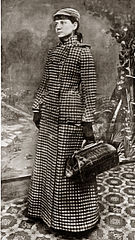 Nellie Bly (born Elizabeth Cochrane Seaman in Armstrong County, Pennsylvania, 1867; died New York, New York, January 22, 1922) was perhaps the leading female journalist of her time. She worked for the Pittsburgh Dispatch, reporting on working conditions, slum life and other topics. She moved to New York and worked on Pulitzer’s New York World. She pretended to be insane, and she was institutionalized. She then reported on the extreme conditions she found there. Perhaps her most exciting adventure came when she followed the route of Jules Verne’s imaginary Phileas Fogg and traveled around the world in 72 days. Children could read or listen to copies of her books at: Project Gutenberg. Children could also read Bonnie Christensen’s The Daring Nellie Bly: America’s Star Reporter.
J. Patrick Lewis (born Gary, Indiana, 1942) has written over 100 poetry and and fiction books for children. His books include the Tugg and Tiny series and What’s Looking at You, Kid?

Inch by Inch
Leo Lionni (born Amsterdam, Netherlands, 1910; died Chianti, Italy, October 11, 1999) was an author/illustrator of over 40 books. He earned four Caldecott Honor Awards: Inch by Inch in 1961, Swimmy in 1964, Frederick in 1968, and Alexander and the Wind-Up Mouse in 1970.
Todd Strasser (born New York, New York, 1950) has written more than 140 books for middle-grade children. He also uses the pen names Morton Rhue and T. S. Rue. His books include The Wave and Thief of Dreams.