Judy Delton (born Saint Paul, Minnesota, 1931; died Saint Paul, Minnesota, December 31, 2001) wrote more than 100 books for children. Her books include the Pee Wee Scouts series, The Goose Who Wrote a Book and Angel in Charge. Children can learn more at: Judy Delton.
Sigmund Freud (born Freiberg, Moravia, 1856; died London, England, September 23, 1939) changed the field of psychiatry. He believed that most behavior was caused by unconscious parts of the brain.
Ted Lewin (born Buffalo, New York, 1935; died July 28, 2021) wrote and/or illustrated at least 200 books for children. He often worked with his wife Betsy. I Was Teenage Professional Wrestler was his autobiography. His illustrations in Peppe the Lamplighter earned him a 1994 Caldecott Honor Award. Children can learn more at: Ted Lewin.
Giulio Maestro (born New York, New York, 1942) has illustrated over 125 books for children. Many of those books were written by his wife Betsy. He has also written some riddle books.
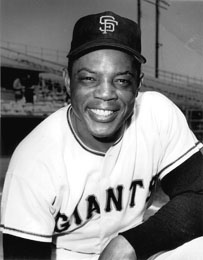
Willie Mays
Willie Mays (born Westfield, Alabama, 1931; died Palo Alto, California, June 18, 2024) was a famous and influential baseball player. An outfielder, he hit 660 homeruns during his career. He is remembered for making a spectacular catch during the 1954 World Series. He was inducted into the National Baseball Hall of Fame in 1979.
Robert E. Peary (born Cresson, Pennsylvania, 1856; died Washington, DC, February 20, 1920) was an explorer. He led eight expeditions to the Arctic. He claimed he found the North Pole on April 6, 1909. Children could learn more at: Peary.
John Penn (born Caroline County, Virginia, 1740; died Williamsburg, North Carolina, September 14, 1788) signed the Declaration of Independence. He represented North Carolina. A lawyer, he also signed the Articles of Confederation. Idea: Children could read about a duel he almost fought. They could also learn more at: John Penn.
 Roosevelt. Woodbridge felt teachers needed a pat on the back, and Roosevelt agreed. She worked with Congress to create a Teacher Appreciation Day. Did you know there are 6.2 million teachers in the United States?
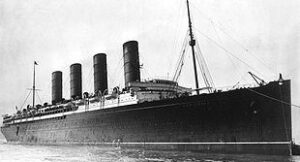 RMS Lusitania sank in 1915. It was torpedoed by Germany, and 1,198 people, including 128 Americans, died. The ship was traveling from New York to Liverpool, England. The United States protested the action, but Germany countered that the ship held munitions for England and was fair game. The sinking created anti-German feelings in the United States, and America declared war on Germany on April 4, 1917.