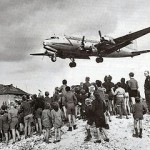
 Operation Little Vittles began in 1948. To understand Operation Little Vittles, we must understand Operation Vittles. After World War II ended. Germany was divided into four sectors, with the United States, France, United Kingdom, and the Soviet Union each in charge of one sector. The Soviet Union’s sector included Berlin. The Soviet Union on June 24, 1948, began blockading Berlin, allowing no food or fuel to enter the city. The other three nations responded by airlifting food and fuel, Operation Vittles, into the desperate city. Colonel Gail Halvorsen was one of the pilots bringing in supplies. He noticed that the children in Berlin got excited to even see a stick of gum. He decided to drop his rations of candy and gum attached to handkerchief parachutes to the children. Thus began Operation Little Vittles. Others heard of his kindness, and individuals and candy makers began donating goodies. Eventually over 23 tons of candy were dropped from about 250,000 small parachutes. On May 13, 1949, the Soviets lifted the blockade, and Operation Vittles and Operation Little Vittles were no longer needed.
Sep 222026