National Gallery of Art opened in 1941 in Washington, DC. President Franklin Roosevelt officiated at the opening. The museum was created in 1937 when a number of wealthy art collectors donated many of their acquisitions to become the core of the exhibits. It has a fine collection of artwork, ranging from the medieval period to the present. Children could visit the Internet site, especially the online tours, at: http://www.nga.gov. They could also pretend to be curators for the National Gallery of Art and decide which works of art to add to the collection. They could also view the amazing children’s portion of the website at: NGA Kids.
Jim Bridger (born Richmond, Virginia, 1804; died near Kansas City, Missouri, July 17, 1881) was a scout and pioneer. He built Fort Bridger in Wyoming as a fur trading post and rest station for settlers traveling on the Oregon Trail.
Gottlieb Wilhelm Daimler (born Schorndorf, Kingdom of Wurttenberg, Germany, 1834; died Bad Cannstatt, Kingdom of Wurttenberg, German Empire, March 6, 1900) is known as the “Father of the Automobile.” He invented the internal combustion engine. Idea: Help students discover how a car engine actually works.
Ralph Fletcher (born Marshfield, Massachusetts, 1953) writes novels, picture books, and poetry books for children and young adults. His books include Fig Pudding and Moving Day.
Kate Greenaway (born London, England, 1846; died London, England, November 6, 1901) wrote and illustrated children’s books. Children can read many of her works at: Project Gutenberg. The highly respected Kate Greenaway Medal is given each year to the best-illustrated book published in the United Kingdom. Children could learn more about Kate Greenaway and the Kate Greenaway Medal by consulting the Children’s Book Award Handbook, by Diana F. Marks.
Lilian Moore (born New York, New York, 1909; died Seattle, Washington, July 20, 2004) wrote about 50 poetry books and easy-to-read books for children. Her works included While You Were Chasing a Hat and I’ll Meet You at the Cucumbers. Children can learn more at: Lilian Moore.
Global Recycling Day is today! Did you know that 52 million tons of paper are recycled every year? Enough plastic is discarded each year to circle the world four times, but most of that could be recycled. Idea: Children could host a recycling event. Children could also learn more at: Global Recycling Day.

Flag of Aruba
Aruba celebrates Flag Day, a national holiday. Claimed by Spain in 1499, Aruba became a Dutch colony in 1636. Still a Dutch possession, Aruba is a bit larger than Washington, DC. Oranjestad is the capital. Because it is located in the Caribbean Sea, the island has a tropical climate. However, it lies outside the hurricane belt and is seldom threatened. Slightly over 100,000 people live on the island, and many of them depend on the 1.5 million tourists who visit the vacation destination.

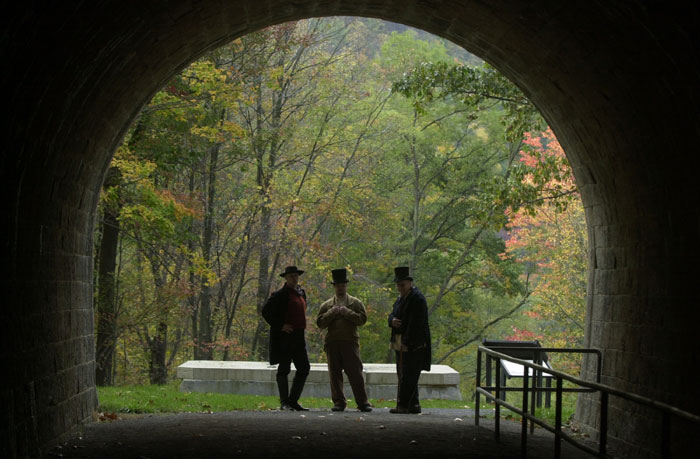
Staple Bend Tunnel
First railroad tunnel in the United States was completed in 1834. Slightly over 900 feet in length, the Staple Bend Tunnel, located in Southwestern Pennsylvania, is rock-bored and lined in stone. Engineers needed three years to dig the tunnel. Today it is a National Historic Landmark. Children can learn more at: Staple Bend Tunnel.
Aleksei Leonov, a Soviet cosmonaut, became the first person to walk in space in 1965. His space walk lasted a bit over twelve minutes, and he was connected to his spacecraft by a tether.

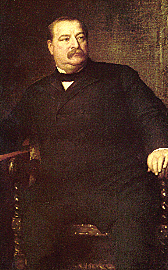
Grover Cleveland
Grover Cleveland (born Caldwell, New Jersey, 1837; died Princeton, New Jersey, June 24, 1908) was the twenty-second and twenty-fourth president of the United States. He was president from 1885 to 1889 and from 1893 to 1897. Born a minister’s son, he was mayor of Buffalo and governor of New York. He was not a very popular president. He applied his veto power over 300 times, more than double the total vetoes of all previous presidents. Children could visit a website at: Grover Cleveland.
Rudolph Diesel (born Paris, France, 1858; died English Channel, September 29, 1913) invented the diesel internal combustion engine.
Douglas Florian (born New York, New York, 1950) writes books for children. His books include Insectlopedia and Laugh-eteria. Children can learn more at: Douglas Florian.
Susan Patron (born Los Angeles, California, 1948; died Los Angeles, California, October 24, 2023) wrote books for children. Her book The Higher Power of Lucky received the 2007 Newbery Medal. One of her recent books is Dear America: Behind the Masks.
Kaethe Zemach (born Boston, Massachusetts, 1958) writes and illustrates books for children. The daughter of writer Harve Zemach and illustrator Margot Zemach, she published her first book at age 14. Her books include The Character in the Book and Just Enough and Not Too Much.
Ptolemy in AD 72 made the first recorded reference to a lunar eclipse. A lunar eclipse occurs when the earth passes between the sun and the moon. At that time the earth’s shadow falls on the moon, causing the eclipse. Lunar eclipses occur between four and seven times a year. Children can learn more about lunar eclipses at: Lunar Eclipse.
American Cliff Swallow
Swallows return to San Juan Capistrano, California. The American cliff swallows arrive after wintering in Argentina. They stay until October 23 when they fly 6,000 miles back to Goya, Argentina. Children could visit a website at: Swallows. They could also read Leo Politi’s classic, Song of the Swallows.
William Bradford (born Yorkshire, England, 1589; died Plymouth, Massachusetts, May 9, 1657) was the second governor of Plymouth Colony, serving from 1621 to 1657. He organized the first Thanksgiving. Much of what we know of Pilgrim life comes from his book Of Plimmoth Plantation. Young adults can read the book at: Project Gutenberg.
William Jennings Bryan (born Salem, Illinois, 1860; died Dayton, Tennessee, July 26, 1925) was known as the “Silver-Tongued Orator.” He championed causes such as the women’s right to vote and the plight of farmers. Children could learn more at: William Jennings Bryan.
Wyatt Earp (born Monmouth, Illinois, 1848; died Los Angeles, California, January 13, 1929) was a frontiersman and a deputy sheriff. At one time he was a buffalo hunter. He and his two brothers were responsible for the fight at the O. K. Corral in Tombstone, Arizona, in 1881.
David Livingstone (born Blantyre, Scotland, 1813; died Africa, May 1, 1873) was a physician, missionary, and the famous missing adventurer. He had been missing for six years. A search party, headed by Henry Stanley, found him near Lake Tanganyika, Africa, on November 10, 1871. Staley tried to convince him to return to Scotland, but Livingstone wanted to continue looking for the source of the Nile River.
Thomas McKean (born New London, Pennsylvania, 1734; died Philadelphia, Pennsylvania, June 24, 1817) signed the Declaration of Independence. A lawyer, McKean attended the Continental Congress. However, he immediately joined the army and battled the British before he returned around 1777 to sign the Declaration of Independence. After the war, he was chief justice of the Pennsylvania Supreme Court, Governor of Delaware, President of the Constitutional Convention, and Governor of Pennsylvania. Children could learn more at: Thomas McKean.
Charles M. Russell (born St. Louis, Missouri, 1864; died Great Falls, Montana, October 26, 1926) was an artist. He was a shepherd and cowboy before he began to paint. His art reflects his interest in the West. Children can learn more at: Charles M. Russell.