Women were allowed to attend military academies, per Congress, in 1975. Today roughly 22 percent percent of the academies’ graduating classes are women.
Sep 222025
Women were allowed to attend military academies, per Congress, in 1975. Today roughly 22 percent percent of the academies’ graduating classes are women.
Michael Faraday (born near London, England, 1791; died Hampton Court, England, August 25, 1867) was an important and famous scientist. He discovered electromagnetism. He also conducted experiments regarding valence. Children could learn more about Faraday at: Michael Faraday. They could also learn how to make an electromagnet at: electromagnet.
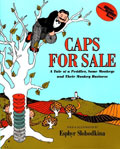
Caps for Sale
Esphyr Slobodkina (born Chelyabinsk, Siberia, 1908; died Glen Head, New York, July 21, 2002) was an author and illustrator. One of her books is Caps for Sale, which has sold more than two million copies. She wrote twenty other books. Children can learn more at: Esphyr Slobodkina.
Junko Tabei (born Japan, 1939; died Japan, October 20, 2016) became on May 23, 1975, the first woman to climb Mount Everest. She was also the first woman to climb the Seven Summits, the highest mountains on each continent. She wrote seven books and created drives to remove the litter left behind by climbers as they scaled Mount Everest.
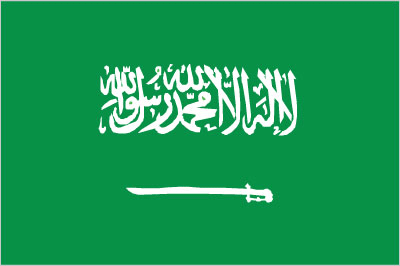
Flag of Saudi Arabia
Saudi Arabia celebrates the 1932 Unification of the Kingdom Day. The country is about one-fifth the size of the United States, and most of the country is covered by desert. Almost 27 million people live in Saudi Arabia, and Riyadh is the capital. Mecca and Medina, Islam’s holiest of shrines, are in Saudi Arabia.
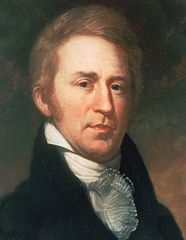
William Clark
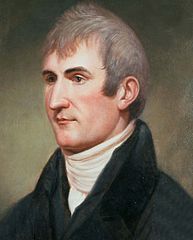
Meriwether Lewis
Lewis and Clark concluded their exploration in 1806. They had left St. Louis, Missouri, on May 14, 1804. Their expedition lasted two years, four months, and ten days, ending in St. Louis, Missouri. Their journals described bison, grizzly bears, and many other animals. Older children could explore a very interesting website: Lewis and Clark.
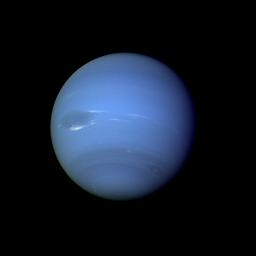
Neptune
Neptune was discovered in 1846. In 1841 John Couch Adams had begun work to find the planet. Urbain J. J. Leverrier, unknown to Adams, had also begun making calculations. Astronomer Johann G. Galle used their predictions and located the planet. Children could learn more at: Neptune.
Hearing aid was patented in 1879. Richard Rhodes received patent number 219,828 for his Audiphone. Children can learn more about hearing aids at: Hearing Aids.
Augustus (born Rome, 63 BC; died Nola, Italy, August 19, 14 AD) was a ruler of ancient Rome.
Bruce Brooks (born Richmond, Virginia, 1950) has written at least twenty books for children and young adults. His book Moves Make the Man earned a 1985 Newbery Honor Award, and What Hearts received a 1993 Newbery Honor Award.
William McGuffey (born Washington County, Pennsylvania, 1800; died Charlottesville, Virginia, May 4, 1873) was an educator and author. He penned the McGuffey Readers, a series of books that taught reading to children. At least 122 million books were sold between 1838 and 1960. Children can view the text of some of these readers at: Project Gutenberg.
Victoria Woodhull (born Homer, Ohio, 1838; died Norton Park, Bremmons, Worcestershire, England, June 10, 1927) was an advocate of women’s rights. She was the first woman candidate for the presidency. She ran for president against Ulysses S. Grant, although women did not have the right to vote. Children could learn more at: Victoria Woodhull.
World Gorilla Day is today! The largest living primates, gorillas live along equatorial Africa. Two species of gorilla exist: eastern and western. Their lifespan in the wild is between 35 to 40 years. They live in troops, and their leader is called a silverback. They are herbivores. Both species are classified as critically endangered by the IUCN.
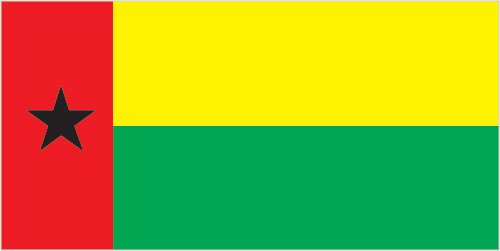
Flag of Guinea-Bissau
Guinea-Bissau celebrates Independence Day. It gained its freedom from Portugal in 1973. Guinea-Bissau, about three times the size of Connecticut, is located at the far western edge of Africa. About 1.6 million people live in the country, and Bissau is the capital.
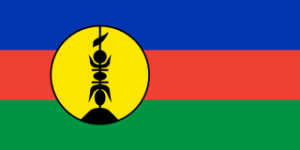
Second Official Flag of New Caledonia
New Caledonia celebrates New Caledonia Day, the day in 1853 when the islands were made a French overseas territory. Still a territorial collectivity of France, the islands lie in Oceania. About the size of New Jersey, the country is home to about 270,000 people. New Caledonia has about 25% of the world’s nickel reserves. Nouméa is the capital.