Nov 032025
 
Panama

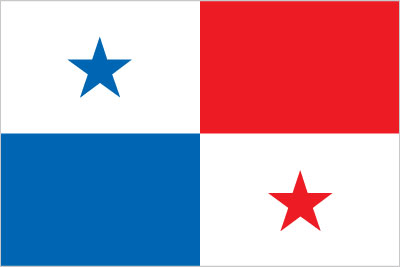
Flag of Panama

Panama celebrates Independence Day. Originally settled by the Spanish, Panama in 1821 was part of the Republic of Gran Colombia. Today’s Colombia, Venezuela, and Ecuador were also included in the Republic. In 1831 the Republic of Gran Colombia disintegrated, and Panama remained part of Colombia. In 1903 Panama broke away from Colombia and formed its own government. Slightly smaller than the state of South Carolina, Panama has a tropical climate. Its population exceeds three million, and the country depends on revenue from the Panama Canal. Panama City is the capital. Farmers in Panama grow a number of crops, including bananas, cocoa, and coffee. Children can learn more at: Panama.
 

Nov 032025
 
Dominica

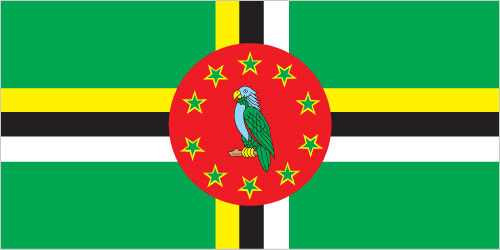
Flag of Dominica

Dominica celebrates Independence Day. Great Britain granted Dominica its independence in 1978. This small (about four times the size of Washington, DC) Caribbean island is located between Guadeloupe and Martinique. Around 70,000 people live among the rainforests and volcanic mountains. Known for its variety of amazing animals and plants (including bananas), the island is home to the world’s second-largest hot spring, Boiling Lake. Roseau is the capital.

Nov 032025
 
Micronesia

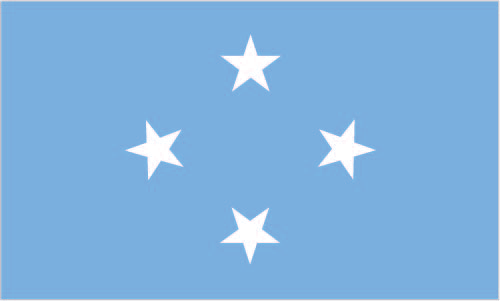
Flag of Micronesia

Micronesia celebrates Independence Day. The archipelago, located in the western Pacific Ocean, gained its freedom from the United States and the United Nations in 1986. Palikir is the capital. The combined area of the 607 islands is about four times the size of Washington, DC. Its tropical climate allows the islanders to grow and export black pepper and bananas. The total population is slightly greater than one hundred thousand.

Nov 032025
 

Sputnik 2, a Soviet spacecraft, was launched in 1957. The Russian spacecraft was the second craft to be launched into earth orbit. It carried the first animal, a dog named Laika, into space. Unfortunately, the dog died hours into the mission from excessive heat and stress.

Nov 042025
 
Tonga

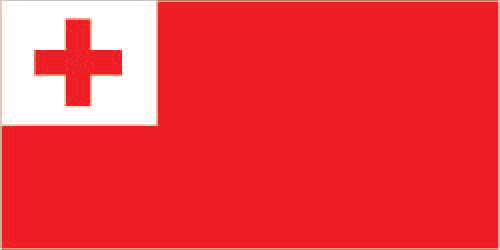
Flag of Tonga

Tonga celebrates Independence Day. It became independent from the United Kingdom in 1970. A constitutional monarchy, Tonga still remains part of the British Commonwealth. The country, located in the South Pacific, is composed of 172 islands. Its total area is about four times the size of Washington, DC. Slightly over 100,000 people live on the islands. Its capital is Nuku’alofa. Captain James Cook explored the area in 1773. Today Tonga exports copra, bananas, and vanilla.

Nov 042025
 

Artificial leg was patented by Benjamin Franklin Palmer in 1846. His invention received patent number 4,834. Children can read about Palmer and his invention at: Palmer.
Cash register was patented in 1879 by James Ritty and John Ritty of Dayton, Ohio. They invented the cash register, called “Ritty’s Incorruptible Cashier,” because they felt employees were stealing money from them. Children can see the patent at the Google patent site at: Cash Register Patent.

Refrigeration apparatus was patented by Thomas Elkins in 1879. He received patent number 221,222. Children can see his patent at the Google patent site at: Refrigeration Patent.

Nov 042025
 

King Tut’s tomb was discovered in 1922. Howard Carter had been looking for the tomb for a number of years. His expeditions had been financed by Lord Carnarvon. Tutankhamen had become pharaoh when he was nine years old. He died at approximately age nineteen. His tomb was one of the few that had never been plundered. The National Museum at Cairo retains the relics. Children can find out more about Howard Carter and take an interactive tour of King Tut’s tomb at: Howard Carter.

Nov 042025
 
Grand Canyon, a UNESCO Site

Grand Canyon, a UNESCO Site

UNESCO (United Nations Educational, Scientific and Cultural Organization) was created in 1946. The goal of UNESCO is to promote “world peace and security through international cooperation in education, the arts, the sciences, and culture.” Children could learn about all the UNESCO World Heritage Sites at: World Heritage Sites.

Nov 052025
 

Guy Fawkes Day is remembered in England. In 1605 at least eleven people plotted to blow up Parliament and kill political leaders, including King James I. They hid twenty barrels of gunpowder in the cellar of the Parliament building. However, the explosives were discovered the night before the intended detonation. The conspirators were tried, convicted, and beheaded. Guy Fawkes is the name most remembered among the guilty. During the evening of November 5, bonfires and fireworks light up the skies. Children can check out the BBC site and play a Guy Fawkes game at: Guy Fawkes Day.