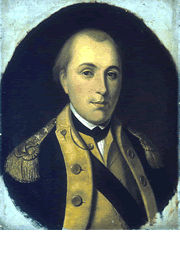
Marquis de Lafayette landed near Charleston, South Carolina, in 1777 to help train patriot forces. Nineteen years old, he became a major-general in the American army without pay. He worked closely with American soldiers, and he also helped America’s cause among the French. After the American Revolution he returned to France to help his own country establish a democracy. Children can learn more from the Liberty’s Kids series: http://www.youtube.com/watch?v=NCFnDuouqxM.

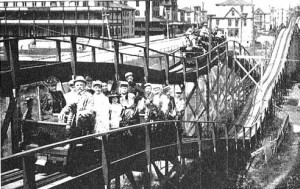
First Roller Coaster
First roller coaster opened in 1884. The “Gravity Pleasure Switchback Railway” of Coney Island dropped 50 feet, and the mechanism traveled six miles per hour. It cost a nickel to ride. Children can design their own roller coasters at: Roller Coaster Design.
Department of Labor was created by Congress in 1888. The Department of Labor is in charge of labor wages and hours, worker safety, unemployment insurance, reemployment activities, and labor statistics. Children can visit the government’s website at: http://www.dol.gov/.
Artist’s Idea of Hayabusa above the Asteroid
Hayabusa returned to earth in 2010 from its trip to collect samples of Near-Earth Asteroid 25143 Itokawa. The unmanned Hayabusa (Peregrine Falcon) launched from a Japanese space center on May 9, 2003, and it landed on the asteroid on November 19, 2005. It collected samples of the asteroid and successfully brought those samples back. The samples reveal that the asteroid is more like a meteorite than an earth rock. Children can learn more at: Hayabusa.
Winfield Scott
Painting by Robert Walter Weir
Winfield Scott (born Petersburg, Virginia, 1786; died West Point, New York, May 29, 1866) was an outstanding military leader. He also negotiated peace treaties with Native Americans. He was nominated twice for the presidency.
Flag Day has been celebrated as a holiday since 1916. John Adams, in 1777, proposed the idea of a flag to the Continental Congress. He went on to describe its colors, stars, and stripes. Children could learn more at: Flag Day.
National Skunk Day is today! Ten species of skunks exist, and they all have stripes. In addition to the usual black and white skunks, other skunks are beige, brown, and gray. They are omnivorous, eating eggs, larvae, worms, berries, leaves, and many other organisms. They use their long front claws to grub for insects and other food. They are crepuscular, meaning they search for food at twilight. They have excellent hearing and smelling, but their vision is limited. Idea: Children could find out if skunks have any predators.

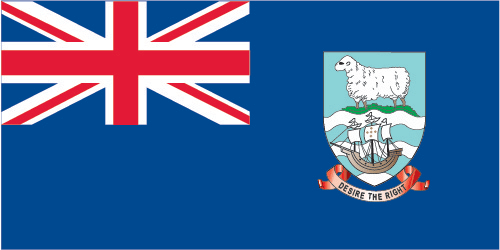
Flag of Falkland Islands
Falkland Islands celebrate Liberation Day, marking the day in 1982 when the British defeated Argentina in the Falkland Islands War. Composed of two main islands and over 700 smaller islands east of Argentina, the Falkland Islands are an Overseas Territory of the United Kingdom. Slightly over 3,000 people live in the Falklands, a region about the size of Connecticut. Stanley is the capital, and fishing is a major industry. Children can learn more at: Falkland Islands
United States Army Insignia
United States Army was created in 1775 by the second Continental Congress. The next day George Washington became commander of the new army.
Sandpaper was patented by Isaac Fischer of Springfield, Vermont, in 1834. Today sandpaper is not made of either sand or paper. Sandpaper is graded by grit size. Course sandpaper has a low number. For example, extra course sandpaper has a number of P12. Ultrafine sandpaper has a number of P6000.