Shays’ Rebellion started formally in 1786. Daniel Shays and other farmers in central Massachusetts were revolting against high taxes and debt policies. At that time if people could not pay their debts, they were put in prison. The resistance was broken around February 1787, and the last vestiges concluded in June 1787. Some experts believe that Shays’ Rebellion influenced members of the Constitutional Convention. Older children could learn more at: Shays’ Rebellion.
The Philanthropist, the first abolitionist newspaper, was printed in 1817. Charles Osborn published the newspaper in Mount Pleasant, Ohio.
Karen Hesse (born Baltimore, Maryland, 1952) has written at least twenty books for children. Her must-read book Letters from Rifka earned the 1992 Sydney Taylor Book Award for Older Readers. Her Out of the Dust received both the 1998 Newbery Medal and the 1998 Scott O’Dell Award for Historical Fiction. Children could visit her blog at: Karen Hesse.
Oliver Wendell Holmes, Sr. (born Cambridge, Massachusetts, 1809; died Boston, Massachusetts, October 7, 1894) was a polymath and poet. He was famous for his charm and wit. In 1830 he wrote a poem, Old Ironsides, that saved the USS Constitution (still in commission) from being destroyed. Children can read some of his works at: Project Gutenberg.
John Locke (born Wrington, United Kingdom, 1632; died High Laver, United Kingdom, October 28, 1704) was a philosopher. Thomas Jefferson was greatly influenced by Locke. Idea: Children could read more about Locke’s philosophy at: Project Gutenberg. Then they could look for strands of that philosophy in the Declaration of Independence.
Lake Pontchartrain Causeway opened in 1956. The 23.86 mile long bridge connects Metairie, Louisiana, and Mandeville, Louisiana. Until 2011 the structure was deemed the longest bridge over water in the world.

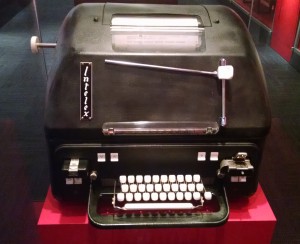
Hotline during Lyndon Baines Johnson Presidency
Direct telephone communication, nicknamed the Hotline, was completed between the White House and the Kremlin in 1963. Legend called the Hotline a red telephone, but it was neither red nor a telephone. At first a teletype machine was used; then Reagan implemented a fax machine. Presently the Hotline is a secure computer link.

Ellen Arthur
Ellen Lewis Herndon Arthur (born Culpeper, Virginia, 1837; died New York, New York, January 11, 1880) was the wife of Chester A. Arthur, twenty-first president of the United States. She was the daughter of William Lewis Herndon, an explorer of the Amazon River. She died before Arthur was ever elected president. Children could visit a website at: Ellen Lewis Herndon Arthur.
Virginia Lee Burton (born Newton Centre, Massachusetts, 1909; died Boston, Massachusetts, October 15, 1968) was a children’s book writer and illustrator. She won the 1943 Caldecott Medal for The Little House. She also wrote and illustrated Mike Mulligan and His Steam Shovel. Children could learn more at: Virginia Lee Burton.
Donald Crews (born Newark, New Jersey, 1938) is a picture book author and illustrator. He has received two Caldecott Honor Awards: in 1979 for Freight Train and in 1981 for Truck. He received the 2015 Laura Ingalls Wilder Award for his body of works.
Laurent de Brunhoff (born Paris, France, 1925) writes and illustrates books for children. His father, Jean de Brunhoff, created the Babar series. Laurent continued to write 45 more Babar books after his father died. He has also written other types of books for children.
Millicent Selsam (born New York, New York, 1912; died New York, New York, October 12, 1996) wrote over 100 books for children. Her books include Greg’s Microscope and Egg to Chick. Children can learn more at: Millicent Selsam.
Mary Wollstonecraft Shelley (born London, England, 1797; died London, England, February 1, 1851) was an author. One of her most famous works is Frankenstein. She was married to poet Percy Bysshe Shelley, and she edited much of her husband’s work after he died. Children can read Frankenstein and many of her other works at: Project Gutenberg.
Roy Wilkins (born St. Louis, Missouri, 1901; died New York, New York, September 8, 1981) was a civil rights leader. The grandson of a slave, he was a driving force in the NAACP. Children could learn more at: Roy Wilkins.
Ted Williams (born San Diego, California, 1918; died Inverness, Florida, July 5, 2002) was a famous baseball player. He was a veteran of both World War II and the Korean War. An outfielder, he was inducted into the Baseball Hall of Fame in 1966. Children could learn more at: Ted Williams.
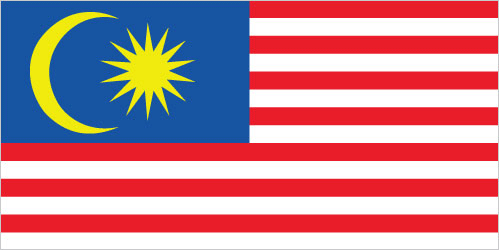
Flag of Malaysia
Malaysia celebrates Independence Day, granted from the United Kingdom in 1957. The country, located in Southeast Asia, has an area about equal to the area of New Mexico. The country has two main portions: part of the peninsula shared by Thailand and the northern portion of Borneo. Almost 30 million people live in this tropical country. The capital is Kuala Lumpur. Children could learn more at: Malaysia.

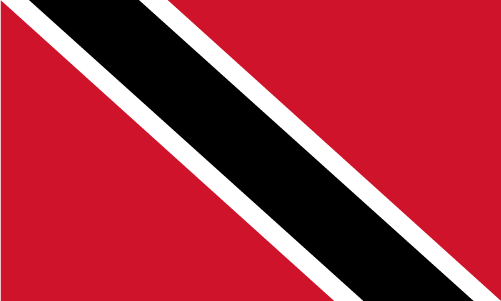
Flag of Trinidad and Tobago
Trinidad and Tobago celebrate Independence Day. The two islands located off the northeastern coast of South America became free of British rule in 1962. The combined area is about the same as the area of Delaware, and over 1.2 million people live there. Port of Spain is the capital. The islands export petroleum, cocoa, and sugar.

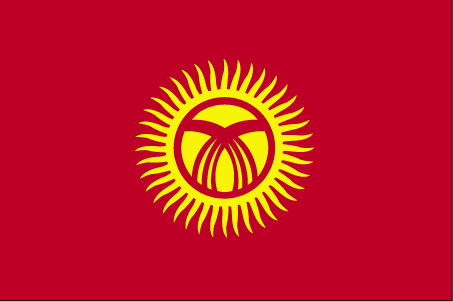
Flag of Kyrgyzstan
Kyrgyzstan celebrates Independence Day. Kyrgyzstan became free of Soviet rule in 1991. This landlocked country, located in eastern central Asia, has an area about equal to the area of South Dakota. Most of the country is covered with mountains. About 5.5 million people live in Kyrgyzstan, and Bishkek is the capital.
John Blair died in 1800 in Williamsburg, Virginia. His exact date of birth (probably in 1732) is unknown. He represented Virginia at the Constitutional Convention and then served on the first United States Supreme Court from 1789 to 1796. Children can learn more at: John Blair.