SOS became the international distress signal in 1906. SOS is • • • ▬ ▬ ▬ • • • in the International Alphabet. Children could learn a bit about Morse code. They could practice sending SOS in Morse code.

SOS became the international distress signal in 1906. SOS is • • • ▬ ▬ ▬ • • • in the International Alphabet. Children could learn a bit about Morse code. They could practice sending SOS in Morse code.
China Clipper, a “flying boat,” left San Francisco, California, and arrived in Manila about sixty hours later. The route it took included stops at Honolulu, Midway Island, Wake Island, and Guam. This 1935 flight started the first trans-Pacific mail delivery system. An interesting fact is that the plane’s navigator was Fred Noonan. He was Amelia Earhart’s navigator when they both disappeared somewhere in the Pacific in 1937.
National Eat a Cranberry Day is today! Traditionally served at Thanksgiving, cranberries are packed with antioxidants and nutrients. The berries release those nutrients best when they are raw, but they are definitely tart! Children could learn about the cranberry bounce test.
Fibonacci Day is today! The mathematical Fibonacci Sequence is a pattern of numbers where the last two numbers are added to make the next number. So.. 1 + 1 = 2; 1 + 2 = 3; 2 + 3 = 5; 3+ 5 = 8; 5 + 8 = 13; 8 + 13 = 21; 13 + 21 = 34 and so on and on…
So how is today Fibonacci Day? Today is 11/23, the start of the Fibonacci Sequence.
What do we do with the Fibonacci Sequence? Many scientists have found examples of the series in nature, such as the arrangement of petals within a flower. Children could view a great TED talk about Fibonacci Numbers at: Fibonacci Numbers. Kids also have fun just extending the pattern to very large numbers. So…you still want more information? The sequence is named after Fibonacci (real name Leonardo Pisano Bigollo), a famous Italian mathematician who lived from around 1170 to 1250. He did not invent the series, but he did broadcast it via his books. He is also famous for spreading the Hindu-Arabic math system, the system we use, throughout Europe.
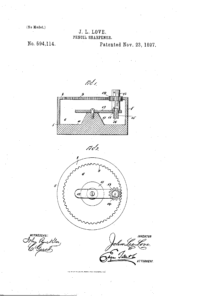
Pencil Sharpener Patent
Pencil sharpener was patented by John Lee Love in 1897. The African American inventor also patented an improved plasterer’s hawk that is still used today. Children can view his pencil sharpener patent at: Pencil Sharpener Patent.
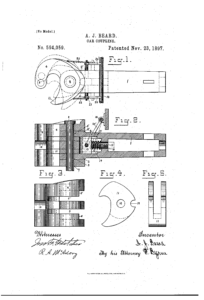
Jenny Coupler Patent
Jenny Coupler was patented by Andrew Jackson Beard in 1899. The African American inventor knew how dangerous it was to couple railroad cars together because he had lost a leg in a railroad car coupling accident. His invention allowed cars to join together by bumping into one another and thus saving many human hands and feet. He sold the rights to his patent for $50,000. Children can examine his patent at: Jenny Coupler Patent.
 Thanksgiving is only three days away! Children could contribute to the celebration by making a special tablecloth. Give children a paper tablecloth and some festive markers. Place scrap paper under the tablecloth to protect underlying surfaces. Children could draw Thanksgiving foods, symbols, or family likenesses. They could also write messages about giving thanks. Children could read A Turkey for Thanksgiving by Eve Bunting or learn more from the Plimoth Plantation website at: Thanksgiving.
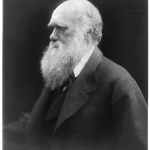
Charles Darwin
Charles Darwin published On the Origin of Species in 1859. The original title was On the Origin of Species by Means of Natural Selection, or the Preservation of Favoured Races in the Struggle for Life. When the sixth edition was printed, the title was shortened to The Origin of Species. The book included information from his time aboard the Beagle expedition in 1830 and other research and correspondence. Children can read The Origin of Species and other books written by Darwin at: Project Gutenberg.

Barbed Wire Patent
Barbed wire was patented in 1874 by Joseph Glidden of Dekalb, Illinois. Ranchers quickly found his invention to be invaluable, and Glidden became very rich. Barbed wire really changed ranching in the West. Young historians could find out the advantages and disadvantages of barbed wire. Children could view his patent at: Barbed Wire Patent.
“Lucy” was found in 1974. Researchers in Hadar, Ethiopia, found hundreds of pieces of bone all from the same skeleton. They named the skeleton Lucy, but her real name is AL 288-1. An Australopithecus afarensis, Lucy is 3.2 million years old. She was about 43 inches tall and probably weighed 65 pounds. Children can visit a fantastic site to learn more at: Lucy.