Corn starch was patented by Orlando Jones in 1841. Jones, a British citizen, received US Patent Number 2000A. One of the main uses of corn starch is as a thickener to soups, stews, gravies, and puddings. It also serves as an anti-caking agent. Examples include its addition to confectioner’s sugar and grated cheese. Children could see the patent at: Corn Starch Patent. Corn starch, when added to a liquid, becomes a non-Newtonian fluid, meaning it is a substance that has both characteristics of a liquid and characteristics of a solid. Children could read Bartholomew and the Oobleck, by Dr. Seuss. Then they could make oobleck by following the recipe in The BIG Book of Glues, Brews, and Goos, by Diana F. Marks.

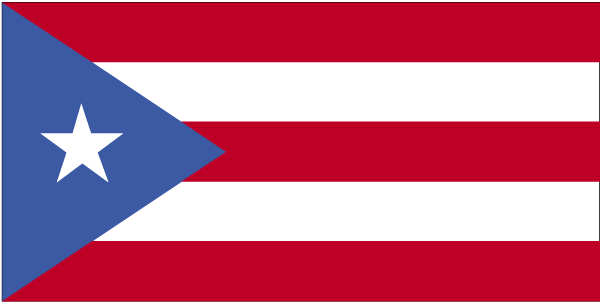
Flag of Puerto Rico
Puerto Rico celebrates Emancipation Day. Slavery was ended on this date in 1873. Puerto Rico at that time belonged to Spain, and the Spanish National Assembly voted to abolish slavery.
LASER (Light Amplification by Stimulated Emission of Radiation) was patented in 1960 by Charles Townes and Arthur Schawlow. Today we do not capitalize all the letters in the word laser. Children can learn how lasers work at: LASER.
Valeri Polyakov in 1995 set a record for living in space for the longest time, 439 days, in the Russian space station Mir. That record has now been broken several times. Cosmonauts and astronauts must adapt to living in space. For example, astronauts must learn to brush their teeth in a different way in space. Children can learn more about daily life in space at: Living in Space.
Randolph Caldecott
Randolph Caldecott (born Chester, England, 1846; died St. Augustine, Florida, February 12, 1886) was a children’s illustrator. At age fifteen he went to work in a bank. However, he always carried a sketchbook with him; and he became an artist in 1872. Two of his works are Three Jovial Huntsmen and The House That Jack Built. Bad health forced him to come to America, but he died shortly after his arrival. Children can view many of his illustrated books at: Project Gutenberg. Around 1938 the American Library Association created the Caldecott Medal to honor the finest American illustrators of children’s books. Children can see more about the Caldecott Medal at: Caldecott. They could also read a biography of Caldecott and learn more about the Caldecott Medal by reading Children’s Book Award Handbook, by Diana F. Marks. Idea: Children could read and study some of the Caldecott winners. They could look at new books and make recommendations for next year’s winner.
Denys Cazet (born Oakland, California, 1938) has written and illustrated at least 35 books for children. His books include the Minnie and Moo series.
Andrew Lloyd Webber (born London, England, 1948) is a composer. His works include Phantom of the Opera and Cats.
Marcel Marceau (born Strasbourg, France, 1923; died Cahors, France, September 22, 2007) was a very famous mime. Idea: Children could produce their own mime acts, perhaps accompanied by Stephen Sondheim’s music or Andrew Lloyd Webber’s music.
James Patterson (born Newburgh, New York, 1947) writes books for children, young adults, and adults. His books for children include I Funny and The Worst Years of My Life. Children can learn more at: James Patterson.
Stephen Sondheim (born New York, New York, 1930; died Roxbury, Connecticut, November 26, 2021) was a composer. His works include Sunday in the Park with George and Into the Woods.
Sir Anthony Van Dyck (born Antwerp, Belgium, 1599; died London, England, December 9, 1641) was an artist. He is most known for his portraits and religious scenes. Children can see many of his works at: Van Dyck.

Flag of Pakistan
Pakistan celebrates Republic Day. According to the CIA World Factbook, Pakistan is slightly less than twice the size of California. It borders the Arabian Sea, and India lies to its east. About 190 million people live in Pakistan. Islamabad is the capital of this mostly agricultural country. Two ancient settlements, Harappa and Mohenjo-Daro, located along the Indus River, are in Pakistan.

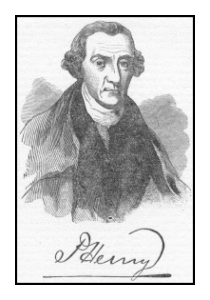
Patrick Henry
Patrick Henry gave his famous “Give me liberty or give me death” speech in Richmond, Virginia, in 1775. The speech, given without notes, was a rousing call for freedom from Great Britain. Children can read the speech at: Patrick Henry.

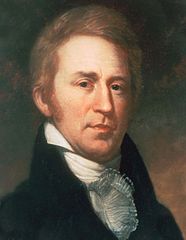
William Clark

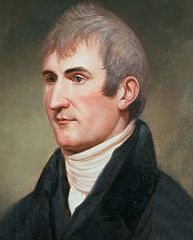
Meriwether Lewis
Lewis and Clark and their Corps of Discovery, after traveling up the Missouri River, across the Rocky Mountains and down the Columbia River, had wintered near the Pacific Ocean. On this day in 1806, they began their journey back to Saint Louis. They triumphantly returned to Saint Louis on September 23, 1806. Children can learn about Lewis and Clark and participate in many excellent activities at: Lewis and Clark.

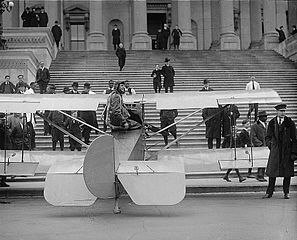
Lawrence Sperry on the Steps of the Capitol Building
Lawrence Sperry landed his Sperry Messenger airplane on the grounds of the Capitol Building in 1922. The plane climbed up some of the steps of the Capitol Building to stop its flight because the plane had no brakes. Some authorities believe Sperry also landed in front of the Lincoln Memorial.
Near Miss Day happened in 1989. The Apollo asteroid 4581 Asclepius, the size of a mountain, came within 500,000 miles of earth. If the meteor had hit the earth, the impact would have left a crater the size of Washington, DC. Children can learn more about meteors in general at: Meteors.