Capitol Reef National Park was establishe
d in 1971. Located in southern Utah, the park follows a one hundred-mile wrinkle in the earth’s crust. Visitors can view fossils, petrified trees, and Native American ruins. Children can visit the park’s website, featuring great panoramas and wonderful photos, at: http://www.nps.gov/care.
Joseph Grimaldi (London, England, 1778; died London, England, May 31, 1837) was known as Joey the Clown. His antics added much to theater humor. Children could become clowns today and wear clown makeup. They could organize into small groups and create clown skits.
Judith Heumann (born Brooklyn, New York, 1947; died Washington, DC, March 4, 2023) was called the “Mother of the Disability Rights Movement.” She contracted polio when she was eighteen months old and used a wheelchair the rest of her life. She organized the 504 Sit In that ultimately produced the 1990 Americans with Disabilities Act. Children could read Fighting for Yes! The Story of Disability Rights Activist Judith Heumann, written by Maryann Cocca-Leffler and illustrated by Vivien Mildenberger.
Paul Klee (born near Bern, Switzerland, 1879; died Muralto, Switzerland, June 29, 1940) was an artist. His paintings exude a dreamlike, fantasy quality. Children could visit a website at: Paul Klee.
Marilyn Sachs (born Bronx, New York, 1927; died San Francisco, California, December 28, 2016) wrote 35 children’s books. Her books include Lost in America and A Pocket Full of Seeds.
Steven Spielberg (born Cincinnati, Ohio, 1946) is a film producer and director. Among his credits are Jurassic Park and Close Encounters of the Third Kind. Idea: Spielberg’s movies are very popular. Children could visit: Spielberg. Scholars could investigate the revenues from the movies and make a bar graph to indicate the results.

Thomas Paine
Thomas Paine published the first of a series of pamphlets called The American Crisis in 1776. His goal was to improve morale of both citizens and soldiers. His words were and still are very effective. His first words were:
THESE are the times that try men’s souls.
The summer soldier and the sunshine patriot will, in this crisis, shrink from the service of their country; but he that stands it now, deserves the love and thanks of man and woman.
Tyranny, like hell, is not easily conquered; yet we have this consolation with us, that the harder the conflict, the more glorious the triumph…”
The last of the pamphlets was printed December 9, 1783. Children can view the entire work at: The American Crisis.

Valley Forge Headquarters
Photo by Carol Highsmith
Valley Forge was the site of Washington encampment during the winter of 1777 and 1778. The army of 10,000 soldiers had to make their own huts. Food and clothing were scarce. About one-fourth of the troops died, and a smallpox epidemic made matters worse. The British, on the other hand, had quite nice conditions in Philadelphia. The arrival of Baron von Steuben and his drilling techniques strengthened the army, and they experienced battle success by June. Children could learn more at: Valley Forge. Children could also read the wonderful book The Riddle of Penncroft Farm, by Dorothea Jensen. It portrays the horrors of the Revolutionary War and the conditions of Valley Forge through the eyes of two adolescents.

Gaia
Gaia was launched in 2013. The unmanned spacecraft, sponsored by the European Space Agency, took off from French Guiana. It had three responsibilities. It marked positions of stars. It measured the luminosity of stars. It measured the velocity of space objects. After many years of successfully fulfilling its missions, it was deactivated March 27, 2025.
Eve Bunting (born Maghera, Northern Ireland, 1928; died Santa Cruz, California, October 1, 2023) was a children’s author. She wrote more than 250 books, including Fly Away Home. She received the 1976 Golden Kite Award for One More Flight. She also received the 1993 Edgar Award for Coffin on a Case. Children can see a video interview of Eve at: Eve Bunting.
Sir William Edward Parry (born Bath, England, 1790; died Ems, Germany, July 8, 1855) was an explorer. He led expeditions to the Arctic in search of the Northwest Passage. Children could explore the concept of the Northwest Passage. Why was it so important to the United Kingdom?
Eleanor H. Porter (born Littleton, New Hampshire, 1868; died Cambridge, Massachusetts, May 21, 1920) was a children’s author. She wrote both short stories and novels. Her most well-known work is Pollyanna, published in 1913. Children can read many of her works, including Pollyanna, at: Project Gutenberg. They can learn more at: Eleanor H. Porter.
Virginia Company left England in 1606 to establish the first colony, Jamestown, in America. Three ships, the Godspeed, the Discovery, and the Susan Constant carried approximately 120 people to their new land. The ships landed May 14, 1607. Older children could read an excellent book, Blood on the River: Jamestown, 1607, by Eliza Carbone. Children could learn more at the National Parks Site: Jamestown.
Louisiana Purchase
Louisiana Purchase was finalized in 1803. The United States bought more than a million square miles of land from France for about twenty dollars a square mile. Children could find out why France sold the land to the United States. What is that land worth now? Children could find more information at: Louisiana Purchase.
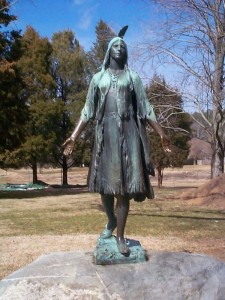
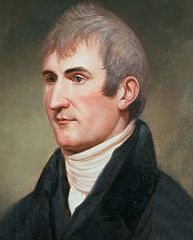
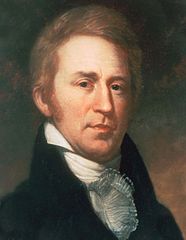
Sacagawea died in 1812 at Fort Manuel on the Missouri River. Her exact birth is unknown; most experts agree on the year 1787. Sacajawea was an interpreter for the Lewis and Clark Expedition. She was a Shoshone Indian who had been captured by enemies. She was sold as a slave to a French-Canadian trapper. She and the trapper joined the expedition. Idea: Many experts believe the expedition would have failed if she had not gone along. Children could investigate and list all that she accomplished by visiting: Sacagawea. They could also read Sacajawea: Crossing the Continent with Lewis and Clark by Emma Carlson Berne.

Montgomery Bus Boyctt
Montgomery, Alabama, bus boycott ended in 1956. A Supreme Court decision forced the bus company to end segregation. The boycott had begun December 5, 1955, over a year before. Children can learn more at: Bus Boycott.